
The Muratorian Fragment: Early Evidence for the New Testament Canon
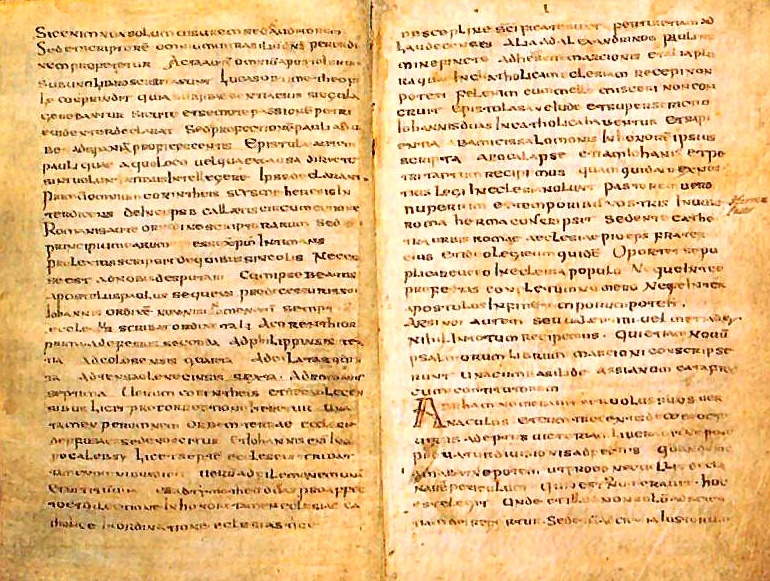
The Muratorian Fragment is the earliest known list of New Testament writings, providing insight into how early Christians recognized and circulated authoritative texts.1 The list itself was composed around AD 170–200, while it survives in a Latin copy made around the 8th century, translated from an original Greek source.
🧭 Introduction
This document is significant because it reflects which Christian writings were considered canonical by the late 2nd century. While it does not cover all New Testament books, it demonstrates that early Christian communities were already distinguishing between widely accepted texts, disputed writings, and apocryphal works.
It’s important to note that the Muratorian Fragment is not a full New Testament canon. It is a fragmentary witness, but its survival offers rare evidence of early canonical development, showing that even within the first two centuries, Christians were developing a recognized set of authoritative texts.
📜 Discovery and Manuscript Evidence
Where and when it was found: The Italian scholar Ludovico Antonio Muratori found the fragment in 1700 in a manuscript at the Ambrosian Library in Milan, which had come from the monastery of Bobbio in northern Italy. He published it in 1740.2,3 The 85-line text is full of copying mistakes, which leaves a few details open to debate.3 The list itself was most likely written in Rome.1
Dating the fragment: Most scholars date it to around 170–200 AD.1 The author himself provides the key clue: he says the Shepherd of Hermas was written "very recently, in our times," while Hermas's brother Pius was bishop of Rome (c. AD 140–154). Although this is more than a century after the earliest New Testament letters were written (Paul’s epistles: c. 50–65 AD), the Muratorian Fragment represents the earliest surviving evidence of a recognized collection of Christian writings.
Why this matters: No complete lists of canonical texts from the first century survive, making the Muratorian Fragment an invaluable witness to early Christian textual recognition. By the late 2nd century, Christians were already distinguishing authoritative texts from disputed or heretical works. This fragment provides a historical anchor for understanding how the New Testament canon began to take shape.
📖 Content of the Fragment
The fragment lists the majority of the books now in the New Testament, including:
-
Four Gospels: While the Muratorian Fragment is physically damaged at the beginning, it provides a vital clue regarding the first two Gospels. The text begins mid-sentence, explicitly referring to Luke as the "third book of the Gospel" and John as the fourth. This structure strongly implies that Matthew and Mark were listed as the first and second books in the now-lost opening portion of the manuscript.
-
Pauline Epistles: All thirteen of Paul’s letters are listed, including Philemon, Titus, and 1–2 Timothy, which Paul wrote “out of affection and love.” Hebrews is absent.
-
Acts of the Apostles: Acts is listed as a continuation of Luke, confirming its early acceptance.
-
General Epistles: The fragment mentions Jude and two letters of John (scholars debate which two), but James, 1 Peter, and 2 Peter are absent.
-
Wisdom of Solomon: Right after Jude and John’s letters, the fragment names the Wisdom of Solomon, a Jewish book that is not part of today’s New Testament. Scholars debate why it appears here. A leading view is that the list counts it as a respected book, but not one of the core writings, the same status it often held in later church lists.3
-
Apocalyptic Writings: The fragment accepts Revelation and the Apocalypse of Peter, adding that “some of us are not willing that the latter be read in church.”
-
Warnings Against False Writings: The fragment rejects letters to the Laodiceans and the Alexandrians as “forged in Paul’s name” to further the heresy of Marcion. It treats the Shepherd of Hermas differently: worth reading privately, but not in public worship, because it was written so recently: "…the Shepherd of Hermas… ought indeed to be read; but it cannot be read publicly to the people in church."1
Summary of Missing or Disputed Books (compared to today’s 27-book New Testament):
-
James
-
1 Peter
-
2 Peter
-
One of John’s letters (the fragment names only two, and scholars debate which)
-
Hebrews (Pauline)
The list demonstrates that by the late 2nd century, 22 of the 27 books in today’s New Testament were already widely recognized.4 However, a few books were still debated or regionally inconsistent. It is important to note that the absence of a book from this single, brief list does not mean it was not considered authoritative or canonical in other Christian communities at the time. The Muratorian Fragment thus provides invaluable evidence of early canonical thinking and the gradual formation of the New Testament.
⚖️ Scholarly Perspectives
Christian scholarship: Most scholars agree that the Muratorian Fragment reflects a real, historical early recognition of Christian scriptures. While there is some debate about exact dating and the original Greek source, the fragment is widely considered authentic and representative of late-2nd-century canonical thinking.
Critical scholarship: Critics often point to the 100+ year gap between the earliest New Testament letters (c. 50–100 AD) and the Muratorian Fragment (c. 170–200 AD), arguing that no surviving 1st-century canonical lists exist, so we cannot confirm precisely which texts were universally accepted immediately after they were written.
More detailed critical analysis also highlights several other points:
-
The Nature of "Authoritative Texts": While the fragment lists texts that were clearly read and valued, some scholars argue that using terms like "authoritative" or "canonical" is anachronistic. They prefer the more cautious phrasing that these were "writings that were read in Christian communities," positing that the idea of a fixed, closed collection of "Scripture" on par with the Old Testament was still an evolving concept.
-
Context of Competing Christianities: Critics emphasize that the Muratorian Fragment is not just a neutral list, but a polemical document created in the context of a "battle for scripture." The list’s explicit rejection of certain writings (like the forged letters to the Laodiceans and Alexandrians) and the inclusion of others served to define orthodox Christianity against Marcion, Gnosticism, and other competing belief systems of the 2nd century. In their view, the canon took shape through conflict, as the church drew lines between itself and rival groups.5
-
A Single Witness: The fragment is a single, brief witness from one specific Christian community (most scholars believe it originated in Rome). It does not necessarily represent the universal consensus of all Christian communities in the late 2nd century, as different regions may have had their own lists and preferences.
Christian Rebuttals and Consensus: Christian scholars, while acknowledging these points, offer important counterarguments. Regarding the 100+ year gap, they note that the survival of first-century documents is extremely rare. Even major Roman histories and legal texts we rely on were preserved only in copies written centuries later. For instance, the works of the Roman historian Tacitus (c. 56–120 AD) survive today only in manuscripts copied roughly 800 years after he wrote them. The absence of earlier canonical lists does not mean they did not exist; it reflects the fragility of ancient manuscripts and the low probability of discovering such artifacts today. The Muratorian Fragment provides the earliest surviving evidence of a canon already in use, and its content strongly suggests that many texts were widely circulated and authoritative decades earlier.
Furthermore, the term "authoritative" is justified because the fragment itself distinguishes between writings "for public reading in church" and those "not suitable," indicating a clear hierarchy of authority already in place. The context of conflict with Gnosticism is not seen as a weakness but as evidence of the early church's careful discernment, actively working to preserve what they believed to be authentic apostolic tradition against heretical teachings. The fact that the list is a single witness is acknowledged, but its broad agreement with later canonical lists, even with some omissions, suggests that it reflects a core consensus already in place across a wide geographic area.
What About a Later Date? A minority of scholars, led by Albert Sundberg and Geoffrey Hahneman, have argued that the list was written in the 4th century.6 Most scholars remain unconvinced, and the evidence explains why:
-
The author dates himself. He says Hermas wrote the Shepherd "very recently, in our times, in the city of Rome, while bishop Pius, his brother, was occupying the chair of the church." Pius led the Roman church around AD 140–154. No 4th-century writer could call that "our times."
-
It fights 2nd-century battles. The heretics it rejects, Marcion, Valentinus, Basilides, and the Montanists, were the controversies of the 2nd century, not the 4th.
-
Its book list fits around AD 200, not the 4th century. It accepts the Apocalypse of Peter, and it omits Hebrews. By the 4th century, the Eastern church that Sundberg and Hahneman propose as its origin had long counted Hebrews among Paul's letters.
-
The late-date case hasn't held up. Bruce Metzger judged Everett Ferguson's reply to Sundberg to "all but demolish" it,1 and Joseph Verheyden concluded that "none of the arguments put forward by Sundberg and Hahneman in favour of a fourth-century, eastern origin of the Fragment are convincing."7 Even Lee Martin McDonald, who favors the later date, cautions that "we cannot insist on that."3,5
Consensus: Most scholars, Christian and critical alike, acknowledge the Muratorian Fragment as the earliest extant witness to an emerging New Testament canon. While details (like exact book order or the nuances of its omissions) are debated, the fragment confirms that by the late 2nd century, there was a recognizable core of authoritative Christian texts, and the gap in surviving documents does not undermine its historical reliability.1,4
🏛️ Historical Significance
The Muratorian Fragment is more than a mere list; it is a window into the early church’s approach to Scripture. It demonstrates that Christians were deliberate about distinguishing inspired writings from other texts circulating in the community. By comparing the fragment with later canonical lists (like Eusebius, Athanasius, and the councils of Hippo and Carthage), scholars can trace the gradual formalization of the New Testament canon.1,5
The fragment also highlights the care with which early Christians preserved the teachings of Jesus and the apostles, ensuring that authentic writings were transmitted faithfully to subsequent generations. In short, the Muratorian Fragment confirms that the New Testament canon did not emerge arbitrarily, but was the result of careful recognition, debate, and preservation within the first two centuries of the church.
📚 References & Image Credits
Metzger, Bruce M. The Canon of the New Testament: Its Origin, Development, and Significance. Oxford: Oxford University Press, 1987.
- A classic, foundational work on the subject, widely cited by scholars of all backgrounds.
Muratori, L. A. Antiquitates Italicae Medii Aevi. Milan, 1740.
- The original publication of the fragment itself.
Schnabel, Eckhard J. "The Muratorian Fragment: The State of Research." Journal of the Evangelical Theological Society 57, no. 2 (2014): 231–64.
- A thorough survey of the manuscript, its text, and the dating debate, including William Horbury's work on the Wisdom of Solomon.
Kruger, Michael J. Canon Revisited: Establishing the Origins and Authority of the New Testament Books. Wheaton: Crossway, 2012.
- A modern, evangelical scholarly work that presents a robust case for the early and divine origins of the canon.
McDonald, Lee Martin. The Biblical Canon: Its Origin, Transmission, and Authority. Peabody: Hendrickson, 2007.
- A highly detailed and comprehensive scholarly survey of the canonical process from a critical-historical perspective; McDonald favors a 4th-century date for the fragment.
Hahneman, Geoffrey Mark. The Muratorian Fragment and the Development of the Canon. Oxford Theological Monographs. Oxford: Clarendon Press, 1992.
- The fullest case for a 4th-century date, the minority view answered in this article.
Verheyden, Joseph. "The Canon Muratori: A Matter of Dispute." In The Biblical Canons, edited by J.-M. Auwers and H. J. de Jonge, 487–556. Leuven: Leuven University Press, 2003.
- A detailed rebuttal concluding that none of the arguments for a 4th-century origin are convincing.
Trobisch, David. The First Edition of the New Testament. Oxford: Oxford University Press, 2000.
- Presents an intriguing, though debated, theory that a single-volume edition of the New Testament was created as early as the mid-2nd century.
Image Credits: Muratorian Fragment. Photo by Biblioteca Ambrosiana, Milan, via Wikimedia Commons. Public domain.
Comments
No comments yet. Be the first to share your thoughts.