
Earliest Papyrus Fragments (P52, P66, P75, P46): Evidence for the Gospels
The earliest physical evidence for the New Testament comes from papyrus fragments that preserve portions of the Gospels and other New Testament writings. These ancient manuscripts such as Papyrus 52 (P52), Papyrus 66 (P66), Papyrus 75 (P75), and Papyrus 46 (P46) offer a window into the transmission of Christian Scripture in the 2nd and 3rd centuries AD, and arguably the late 1st. They demonstrate that the texts of the New Testament were already circulating widely, copied, and read by early Christian communities.
Even small fragments like P52 confirm that the Gospel of John existed in textual form within a few decades of its original composition. Larger manuscripts like P66, P75, and P46 contain substantial portions of text, preserving the content and wording of the New Testament with a high degree of textual continuity.1,2
📜 Discovery and Manuscript Evidence
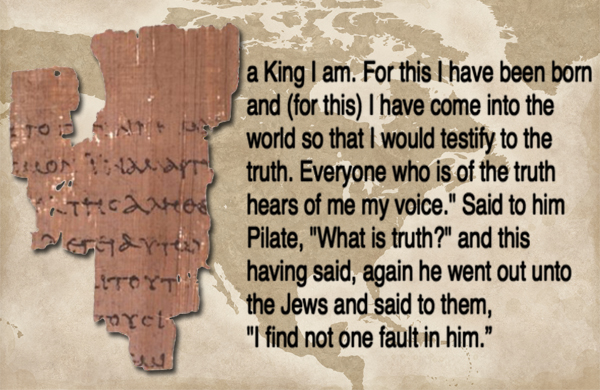
Papyrus 52 (P52) – John Rylands Library Papyrus
-
Date: Around 90–150 AD. It is generally dated to the first half of the 2nd century, though some scholars, following Adolf Deissmann, place it as early as the late 90s.1,2,3,4
-
Contents: A small papyrus fragment containing John 18:31–33, 37–3831 Pilate said to them, “Take him yourselves and judge him by your own law.” The Jews said to him, “It is not lawful for us to put anyone to death.” 32 This was to fulfill the word that Jesus had spoken to show by what kind of death he was going to die., making it the earliest known New Testament fragment.
-
Significance: Even this tiny scrap confirms that the Gospel of John, one of the last books of the New Testament to be written, was being copied and circulated within a generation of its composition, highlighting the early recognition and transmission of the text.1
Papyrus 66 (P66) – Bodmer Papyrus II
-
Date: Late 2nd century AD, approximately 175–225 AD.
-
Contents: A nearly complete manuscript of the Gospel of John, covering chapters 1–21.
-
Significance: P66 preserves nearly the entire Gospel of John, and where it overlaps with the earlier P52, the two agree closely. This continuity between separate manuscripts shows that the Gospel text was stable from an early date.1,2 P66 also shows how errors were caught: its scribe went back over his own work and fixed hundreds of small slips, such as misspellings and skipped words.5
Papyrus 75 (P75) – Bodmer Papyrus XIV–XV
-
Date: Early 3rd century AD, ~200 AD.
-
Contents: Contains significant portions of Luke 3:18–24:53 and John 1:1–15:8.
-
Significance: P75 provides one of the earliest witnesses to both Luke and John, showing textual agreement with later major codices like Vaticanus (B), and confirming that the Gospel texts were reliably transmitted over more than a century.1,2
Papyrus 46 (P46) – Chester Beatty Papyrus
-
Date: Late 2nd century AD, around 175–225 AD.
-
Contents: A well-preserved manuscript of Paul's letters. It contains Romans, 1–2 Corinthians, Galatians, Ephesians, Philippians, Colossians, and part of 1 Thessalonians, along with Hebrews; some pages are missing.
-
Significance: P46 offers early evidence for the circulation and textual stability of Paul's epistles, showing that the New Testament letters were recognized and copied alongside the Gospels.
Other Notable Fragments
In addition to P52, P66, P75, and P46, several smaller fragments provide further evidence of early Christian textual transmission:6
-
Papyrus P77: A fragment of the Gospel of Matthew (Matthew 23:30–3930 saying, ‘If we had lived in the days of our fathers, we would not have taken part with them in shedding the blood of the prophets.’ 31 Thus you witness against yourselves that you are sons of those who murdered the prophets.), dated to ~150–225 AD.
-
Papyrus P90: Contains John 18:36–19:7, estimated to ~150–200 AD.
-
Papyrus P98: A fragment of Revelation (Revelation 1:13–2:1), dating to ~150–175 AD.
-
Papyrus P104: A small fragment containing a portion of the Gospel of Matthew (Matthew 21:34–37, 43, 4534 When the season for fruit drew near, he sent his servants to the tenants to get his fruit. 35 And the tenants took his servants and beat one, killed another, and stoned another.), dated to the late 2nd century.
-
Papyrus P106: Contains parts of the Gospel of John (John 1:29–35, 40–4629 The next day he saw Jesus coming toward him, and said, “Behold, the Lamb of God, who takes away the sin of the world! 30 This is he of whom I said, ‘After me comes a man who ranks before me, because he was before me.’), dated to the 3rd century AD.
These fragments, though small, demonstrate that early Christian texts were widely read and carefully copied, providing further evidence of the early recognition and transmission of the New Testament writings.
📖 Why the Papyrus Fragments Matter
The papyrus discoveries illustrate that the Gospels were already circulating and being copied carefully within the first two centuries of Christianity. While gaps exist in the surviving evidence, the overall uniformity of these manuscripts demonstrates the faithful preservation of the New Testament texts.
Even a fragment as small as P52 shows that the Gospel of John was read and transmitted within a generation of its composition. Larger codices such as P66 and P75 confirm that the text was stable, consistent, and authoritative, offering strong support for the historical reliability of the Gospels.
📜 Why Papyrus Fragments Are So Small
The small size of these fragments reflects the realities of ancient bookmaking and preservation, not a lack of reliability:
-
Material Fragility: Papyrus, made from pressed reed fibers, is highly perishable. In typical climates, manuscripts often survived only decades to a century before deteriorating. Humidity, heat, and regular handling all accelerated decay. By contrast, the dry sands of Egypt preserved papyri far longer, explaining why so many early fragments come from there.
-
Writing Practices: Early Christians favored the codex, an early form of the book, over the scroll.7 Most codices held just one book or a few, and once a binding wore out, its pages could easily separate and scatter.
-
Accidental Loss: Fires, wars, neglect, and natural decay destroyed many manuscripts. The fragments that survived often did so by chance in favorable climates.
-
Answering Scholarly Criticism: Some critics argue that small scraps like P52 are too limited to be useful. Yet even these fragments contain enough text to compare across manuscripts. In the case of P52, the verses align closely with later copies, showing remarkable continuity despite the time gap.
-
Evidence of Wide Circulation: Nearly all early papyri were found in Egypt, where the dry climate preserved them. The books they contain, however, were written elsewhere, such as John's Gospel and Paul's letters to churches in Greece and Asia Minor. Within a few generations, these books were being copied and read hundreds of miles from home.
🔎 Conclusion
The small size of early papyrus fragments is a natural result of ancient materials and history, not a weakness of the biblical record. Far from undermining the New Testament, these discoveries provide tangible, early, and geographically dispersed evidence of the careful transmission of Christian Scripture.
📚 References
Comfort, Philip W., and David P. Barrett. The Text of the Earliest New Testament Greek Manuscripts. Tyndale House, 2001.
- Resource providing detailed transcriptions and photos of the earliest papyri.
Metzger, Bruce M., and Bart D. Ehrman. The Text of the New Testament: Its Transmission, Corruption, and Restoration. 4th ed., Oxford University Press, 2005.
- The foundational textbook on New Testament textual criticism, explaining how these early fragments fit into the broader history of the Bible.
Roberts, C. H. An Unpublished Fragment of the Fourth Gospel in the John Rylands Library. Manchester University Press, 1935.
- The original academic publication of P52, which first established its significance as the earliest known New Testament fragment.
Thiede, Carsten Peter. The Dead Sea Scrolls and the Jewish Origins of Christianity. Palgrave Macmillan, 2000.
- Offers a detailed defense of earlier handwriting dates for New Testament fragments, supporting the possibility of late 1st-century compositions.
Royse, James R. Scribal Habits in Early Greek New Testament Papyri. Brill, 2008.
- A detailed study of the earliest papyri, including P66, whose corrections Royse attributes almost entirely to the original scribe.
Institut für Neutestamentliche Textforschung (INTF). "Liste (Greek)." New Testament Virtual Manuscript Room, University of Münster.
- The official register of Greek New Testament manuscripts, including the contents and dates of each papyrus.
Hurtado, Larry W. The Earliest Christian Artifacts: Manuscripts and Christian Origins. Eerdmans, 2006.
- Provides insight into the physical nature of papyrus and why the early Christian preference for the "codex" (book) format was revolutionary.
Image Credits: Papyrus 52 (Rylands Library Papyrus P52), recto side containing John 18:31–3331 Pilate said to them, “Take him yourselves and judge him by your own law.” The Jews said to him, “It is not lawful for us to put anyone to death.” 32 This was to fulfill the word that Jesus had spoken to show by what kind of death he was going to die.. Dated c. 90–150 AD. John Rylands Library, Manchester. Public domain.
Comments
No comments yet. Be the first to share your thoughts.