
The Caiaphas Ossuary: Archaeological Evidence of the High Priest
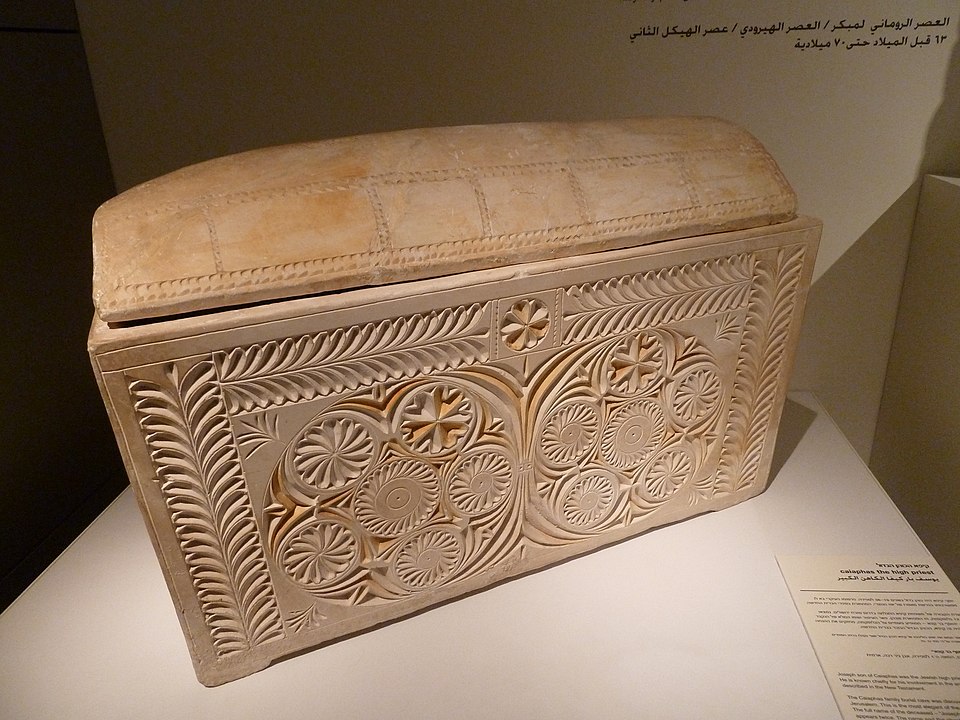
The Caiaphas Ossuary is an archaeological discovery that provides evidence strongly associated with Joseph Caiaphas, the Jewish high priest during Jesus’ trial in the early 1st century AD. Discovered in Jerusalem in 1990, this limestone burial box (ossuary) bears the inscription “Joseph, son of Caiaphas,” linking it to the high priest mentioned in the Gospels of John and Matthew.1 This archaeological find is significant because it confirms the historical existence of a key figure in the New Testament narrative, supporting its historical reliability.
🏺Discovery and Description
In 1990, construction workers uncovered a burial cave in the Peace Forest area of Jerusalem. In the cave, they found twelve ossuaries, two of which were inscribed with forms of the name “Caiaphas.” The most elaborate of these ossuaries bears the inscription “Joseph son of Caiaphas” in two places.2 The ossuary also contained the remains of six individuals, including a man approximately 60 years old, which is consistent with the chronology of Caiaphas’s known career as high priest during the lifetime of Jesus.2,4
📖 Biblical Significance
Caiaphas appears explicitly in the New Testament in John 11:49–5249 But one of them, Caiaphas, who was high priest that year, said to them, “You know nothing at all. 50 Nor do you understand that it is better for you that one man should die for the people, not that the whole nation should perish.” and Matthew 26:5757 Then those who had seized Jesus led him to Caiaphas the high priest, where the scribes and the elders had gathered.:
John 11:49-5249 But one of them, Caiaphas, who was high priest that year, said to them, “You know nothing at all. 50 Nor do you understand that it is better for you that one man should die for the people, not that the whole nation should perish.” - "But one of them, Caiaphas, who was high priest that year, said to them, 'You know nothing at all. Nor do you understand that it is better for you that one man should die for the people, not that the whole nation should perish.' Now he did not say this of his own accord, but being high priest that year he prophesied that Jesus would die for the nation, and not for the nation only, but also to gather into one the children of God who are scattered abroad"
Matthew 26:5757 Then those who had seized Jesus led him to Caiaphas the high priest, where the scribes and the elders had gathered. - "Then those who had seized Jesus led him to Caiaphas the high priest, where the scribes and the elders had gathered."
Additionally, Matthew 26:63–6463 But Jesus remained silent. And the high priest said to him, “I adjure you by the living God, tell us if you are the Christ, the Son of God.” 64 Jesus said to him, “You have said so. But I tell you, from now on you will see the Son of Man seated at the right hand of Power and coming on the clouds of heaven.” and Mark 14:5353 And they led Jesus to the high priest. And all the chief priests and the elders and the scribes came together. refer to the high priest during Jesus’ trial but do not mention his name. On the other hand, Luke 3:22 during the high priesthood of Annas and Caiaphas, the word of God came to John the son of Zechariah in the wilderness. and Acts 4:66 with Annas the high priest and Caiaphas and John and Alexander, and all who were of the high-priestly family. directly refer to Caiaphas in a different context:
Luke 3:22 during the high priesthood of Annas and Caiaphas, the word of God came to John the son of Zechariah in the wilderness. - "during the high priesthood of Annas and Caiaphas, the word of God came to John the son of Zechariah in the wilderness."
Acts 4:66 with Annas the high priest and Caiaphas and John and Alexander, and all who were of the high-priestly family. - "with Annas the high priest, Caiaphas, John, and Alexander, and all who were of the high-priestly family."
These passages collectively show that Caiaphas was the recognized high priest at the time of Jesus’ ministry, providing a clear historical anchor for the ossuary.
📜 Historical Significance
The importance of the Caiaphas Ossuary is strengthened by the cumulative evidence for Caiaphas’s role as high priest. Josephus also records his role in Jewish leadership during the early 1st century AD, placing him in the same historical setting as the Gospel accounts.4 The ossuary adds archaeological weight to this written record, connecting a named biblical figure to the material world of first-century Jerusalem.
⚖️ Authenticity and Scholarly Debate
Scholars widely accept the ossuary as an authentic first-century artifact. While absolute identification cannot be proven, the inscription, burial context, elaborate craftsmanship, and historical naming patterns strongly support its association with Joseph Caiaphas, the high priest known from the New Testament and Josephus. Although some scholars have questioned details of the inscription or the relative plainness of the tomb, the cumulative evidence makes the identification highly probable.3,5
🏛️ Why This Discovery Matters: Historical Validation
The Caiaphas Ossuary provides tangible archaeological evidence strongly connected to Caiaphas, a central figure in the trial of Jesus. Since Josephus already attests him as high priest, the ossuary does not stand alone, but substantially reinforces the historical accuracy of the Gospels and Acts. As a physical artifact tied to a named New Testament figure, it adds significant weight to the reliability of the biblical narrative.
📚 References
Windle, Bryan. “Caiaphas: An Archaeological Biography.” Bible Archaeology Report, April 17, 2025. (Accessed February 24, 2026).
Greenhut, Zvi. “The ‘Caiaphas’ Tomb in North Talpiyot, Jerusalem.” ’Atiqot21 (1992): 68–70.
"Ossuary of the High Priest Joseph Caiaphas." Center for Online Judaic Studies
Flavius Josephus. Antiquities of the Jews 18.2.2.
Reich, Ronny. “Ossuary Inscriptions from the Caiaphas Tomb.” Jerusalem Perspective 33/34 (1991): 13–22. (Accessed July 20, 2026).
Image Credits: Caiaphas Ossuary — Photo by or_avi, Wikimedia Commons, CC BY-SA 3.0
Comments
No comments yet. Be the first to share your thoughts.