
The Tel Dan Stele: From Myth to History

For much of the 20th century, critics of the Bible argued that King David was little more than a literary invention. He was often portrayed as a mythic ruler created by later Hebrew writers to provide Israel’s monarchy with a noble origin. In the absence of corroborating evidence outside Scripture, David was frequently compared to figures such as King Arthur, regarded as a possible folk hero rather than a historically verifiable king.
Then, in the 1990s, a broken basalt stone was unearthed in northern Israel and it changed everything.
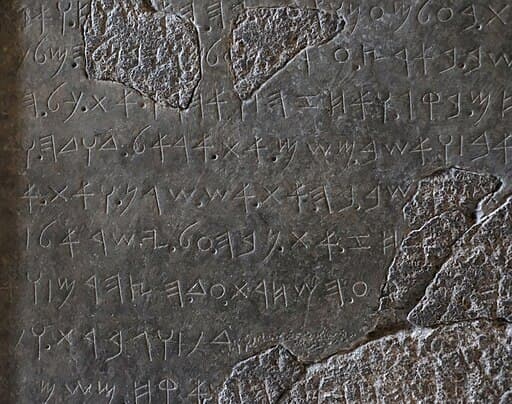
Known today as the Tel Dan Stele, this 9th-century BC inscription contains a direct reference to the “House of David.” That single phrase provided the first historical evidence outside the Bible that a real dynasty, founded by a ruler named David, was recognized by surrounding nations less than two centuries after his lifetime.
As the Biblical Archaeology Society observed:
“The stela’s fragmented inscription, first read and translated by the renowned epigrapher Joseph Naveh, proved that King David from the Bible was a genuine historical figure and not simply the fantastic literary creation of later Biblical writers and editors.”1
Once again, archaeology moved the goalpost of skepticism: where some critics saw myth, the spade unearthed history. Like countless other discoveries before it, the Tel Dan Stele stands as a significant example of how archaeological evidence continues to affirm the historical reliability of Scripture, even in details once dismissed as legend.
🏺 Archaeological Findings
The Tel Dan Stele was unearthed in 1993 and 1994 during excavations led by archaeologist Avraham Biran at Tel Dan in northern Israel. One July afternoon in 1993, the team’s surveyor, Gila Cook, was finishing her measurements near the city gate. The low sun picked out letters carved into a basalt stone lying in the rubble of an ancient wall. Two smaller pieces of the same inscription turned up the following summer, but Cook’s fragment held the line that mattered most. On it, Israel’s ancient enemies had carved the very name skeptics dismissed as legend: the “House of David.”
The inscription, written in ancient Aramaic on a fragmentary basalt stele, dates to the 9th century BC, within roughly 150 years of King David’s reign. It records the victories of an Aramean king (most likely Hazael of Aram-Damascus) who boasts of defeating “the king of Israel” and “the king of the House of David.”
This remarkable find provides the earliest known historical reference to David outside the Bible, confirming that a Davidic royal house was recognized as a real political entity by neighboring nations. What was once regarded as mythic now stands inscribed in stone as a remarkable witness to the historical foundations of Israel’s monarchy.
🎓 Scholarly View
This discovery sent ripples through the academic world. The key lines, as restored and translated by the stele’s first editors, Avraham Biran and Joseph Naveh, read (brackets mark letters lost where the stone is broken):
“[I killed Jeho]ram son [of Ahab] king of Israel, and [I] killed [Ahaz]iahu son of [Jehoram kin]g of the House of David.”2
The two titles that matter, “king of Israel” and “House of David,” survive on the stone itself.
Today, the scholarly consensus affirms that a historical figure named David existed and founded a recognized dynasty in the ancient Near East, marking a significant shift from earlier skepticism. While the debate over David’s existence has mostly ended, some have shifted the question to the extent of his kingdom. Minimalists argue the biblical account exaggerates his power. While the full extent of David’s reign remains archaeologically unknown, that skepticism reflects the fragmentary survival of ancient data rather than counter-evidence.
What the Tel Dan Stele does is establish dynastic reality. The reference to the “House of David,” recorded by a foreign adversary, confirms that David was remembered as the founder of a lasting royal line. In this way, the stele anchors the Davidic dynasty firmly within the historical record.
📖 Biblical Significance
The Tel Dan Stele bridges the world of biblical text and ancient history. The Bible presents David not only as Israel’s second king but as the dynasty through which the Messiah was foretold to come (Isaiah 11:1–21 There shall come forth a shoot from the stump of Jesse, and a branch from his roots shall bear fruit. 2 And the Spirit of the Lord shall rest upon him, the Spirit of wisdom and understanding, the Spirit of counsel and might, the Spirit of knowledge and the fear of the Lord., Jeremiah 23:5–65 “Behold, the days are coming, declares the Lord, when I will raise up for David a righteous Branch, and he shall reign as king and deal wisely, and shall execute justice and righteousness in the land. 6 In his days Judah will be saved, and Israel will dwell securely. And this is the name by which he will be called: ‘The Lord is our righteousness.’, Jeremiah 33:14–1714 “Behold, the days are coming, declares the Lord, when I will fulfill the promise I made to the house of Israel and the house of Judah. 15 In those days and at that time I will cause a righteous Branch to spring up for David, and he shall execute justice and righteousness in the land., Psalm 89:3–4, 29–363 You have said, “I have made a covenant with my chosen one; I have sworn to David my servant: 4 ‘I will establish your offspring forever, and build your throne for all generations.’” Selah).
The phrase “House of David” inscribed on the stele confirms that neighboring kingdoms (likely the Arameans) recognized this dynasty by name. It’s one thing for Scripture to make that claim, but it’s another for an enemy nation to record it in stone.
🏛️ Why This Discovery Matters: Archaeology and the Reliability of Scripture
The Tel Dan Stele is more than an artifact; it’s a reminder that the Bible stands up to scrutiny. Time and again, archaeology has unearthed names, places, and events once thought to be legendary: the pools of Bethesda and Siloam, the reign of Hezekiah, and now, the dynasty of David.
Each find narrows the space for doubt, showing that the Bible’s historical core is not fantasy but fact. The Tel Dan Stele stands as another concrete witness to the truth of Scripture.
📚 References
Biblical Archaeology Society. "The Tel Dan Inscription: The First Historical Evidence of King David from the Bible." Accessed October 4, 2025.
Biran, Avraham, and Joseph Naveh. “An Aramaic Stele Fragment from Tel Dan.” Israel Exploration Journal, vol. 43 (1993): 81–98; and “The Tel Dan Inscription: A New Fragment.” Israel Exploration Journal, vol. 45 (1995): 1–18.
Image Credits: Tel Dan Stele, Israel Museum. Photo by Yael Y (יעל י), Wikimedia Commons. CC BY-SA 3.0. Available here.

Comments
No comments yet. Be the first to share your thoughts.