
The Mesha Stele (Moabite Stone)
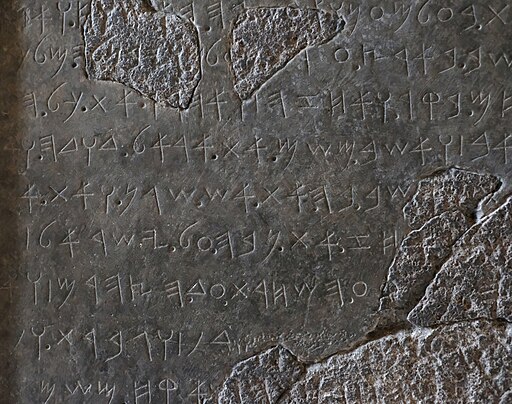
Few archaeological discoveries have illuminated the biblical world quite like the Mesha Stele, also known as the Moabite Stone. The stele stands as a vivid first-person account from King Mesha of Moab, a nation often at odds with ancient Israel. Written in Moabite, a dialect closely related to biblical Hebrew, the 34-line inscription dates to around 840–830 BC, during the reign of the Israelite kings Omri and Ahab.
🗿 Discovery and Historical Context
The Mesha Stele was discovered in 1868 at Dibon (modern-day Dhiban, Jordan) by an Anglican missionary. Though the original stone was later damaged during local conflict, scholars preserved its text through fragments and an early paper impression.1
Today, the Mesha Stele is housed in the Louvre Museum in Paris, where it remains one of the longest and most significant Iron Age texts in the region and one that strikingly parallels the biblical record.
📜 Biblical Parallels
In 2 Kings 3, Scripture records how Mesha, king of Moab, rebelled against Israel after King Ahab’s death:
“Mesha king of Moab was a sheep breeder, and he had to deliver to the king of Israel 100,000 lambs and the wool of 100,000 rams. But when Ahab died, the king of Moab rebelled against the king of Israel.” — 2 Kings 3:4–54 Now Mesha king of Moab was a sheep breeder, and he had to deliver to the king of Israel 100,000 lambs and the wool of 100,000 rams. 5 But when Ahab died, the king of Moab rebelled against the king of Israel. (ESV)
The Bible recounts that Moab had been subdued under Ahab’s father, Omri, and that Israel launched a retaliatory campaign after Mesha’s revolt.
The Mesha Stele parallels this story almost point-for-point. Mesha boasts that “Omri, king of Israel, oppressed Moab for many days,” and that his son continued this domination until Mesha’s god Chemosh supposedly granted victory.
While the biblical account emphasizes Israel’s military strength and God’s deliverance, the Moabite inscription presents the same conflict through the eyes of Israel’s enemy, crediting Chemosh for freeing Moab from oppression.
Both texts describe the same historical event from opposite theological lenses, offering one of the clearest and most compelling examples of synchrony between archaeology and Scripture.
⚖️ The “House of David” Debate
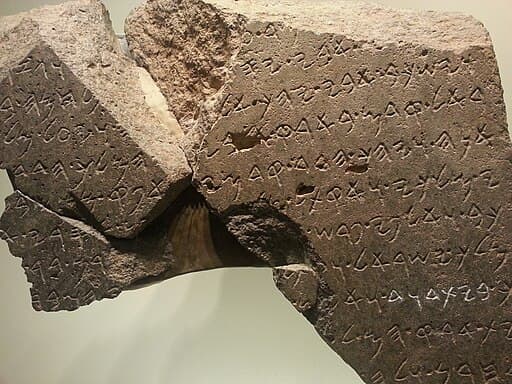
The most debated line in the inscription appears in a damaged section that some scholars interpret as referring to the “House of David.” If this reading is correct, it would mark the second earliest extrabiblical reference to David’s dynasty after the Tel Dan Stele.
Estimates among scholars differ regarding the possible reference to the “House of David” on the Mesha Stele. While some epigraphers and historians see the damaged letters bt dwd (“House of David”) as a plausible reading that fits the context, others remain cautious due to the fragmentary nature of the text.2
Alternative reconstructions have been proposed, such as a reference to a local ruler or place name. For an in-depth exploration of the scholarly debate and the evidence for this interpretation, see the articles from the Biblical Archaeology Society listed in the references section.1
However, even for those who remain cautious, the possibility is significant and suggests that Israel’s royal lineage was well known to neighboring nations centuries after David’s reign.
🏛️ Why the Mesha Stele Matters
The significance of the Mesha Stele reaches far beyond its possible Davidic reference. It stands as one of the clearest confirmations that the world described in Scripture was a real, political, and historical landscape and not a later invention.
-
It verifies Omri’s reign, one of Israel’s most prominent northern kings, directly confirming details recorded in 1 and 2 Kings.
-
It corroborates Israel’s conflict with Moab, preserving the same event described in the Bible but from the viewpoint of Israel’s enemy.
-
It highlights linguistic and cultural continuity between Moabite and Hebrew, offering scholars a rare window into the shared heritage of Israel’s neighbors.
-
It bridges faith and history, showing that archaeology repeatedly affirms the existence, names, and events found in Scripture.
Each new discovery like the Mesha Stele further confirms the historical reliability of Scripture, revealing just how well-documented and grounded the Bible truly is.
For both historians and theologians, the Mesha Stele serves as yet another powerful example of how archaeology can illuminate the biblical record and amplify its voice through the stones of history.
📚 References
Biblical Archaeology Society. (2022–2023). Mesha Stele and the House of David. Available at:
Langlois, Michael. “The Kings, the City and the House of David on the Mesha Stele.” Semitica61 (2019): 23–47. PDF available at MichaelLanglois.org.
Image Credits: Mesha Stele (AO 5066) — Detail of Moabite inscription. Photo by rk-w, via Wikimedia Commons. Available here.
Comments
No comments yet. Be the first to share your thoughts.