
Excavating Jerusalem's Miraculous Pools: Bethesda & Siloam
Thanks to modern archaeology, two ancient pools in Jerusalem, Bethesda and Siloam, have been brought to life, exactly where the Gospel of John describes miraculous healings. Excavations have uncovered their structure and features with astonishing detail, confirming the historical setting of the biblical accounts.

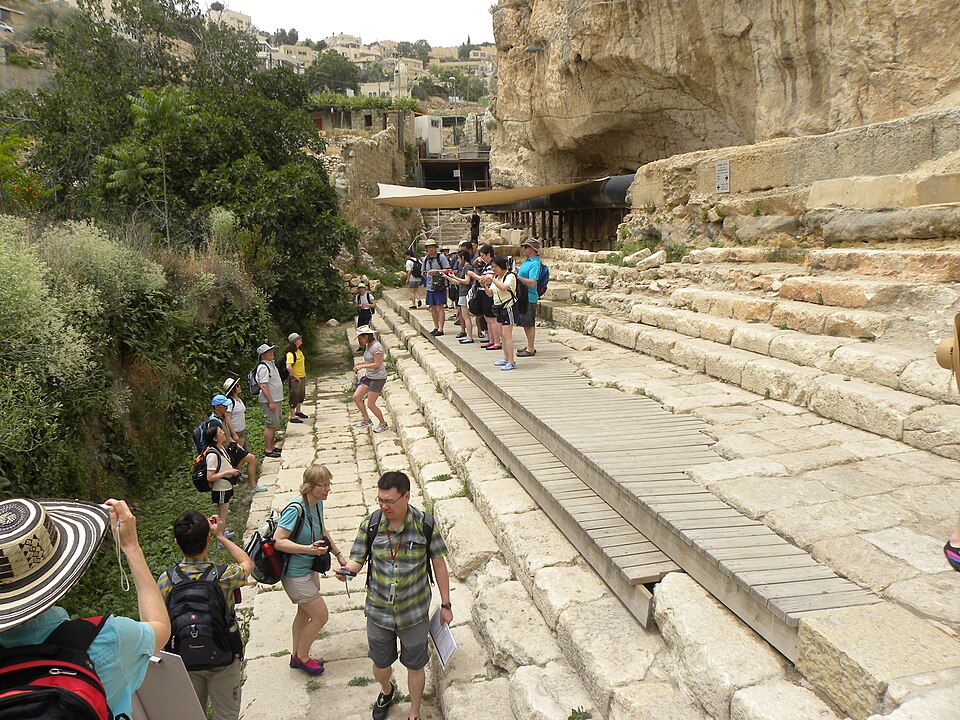
💧 Pool of Bethesda
Biblical Significance: In John 5:2–92 Now there is in Jerusalem by the Sheep Gate a pool, in Aramaic called Bethesda, which has five roofed colonnades. 3 In these lay a multitude of invalids—blind, lame, and paralyzed. (ESV), it is written:
“Now there is in Jerusalem by the Sheep Gate a pool, in Aramaic called Bethesda, which has five roofed colonnades. In these lay a multitude of invalids—blind, lame, and paralyzed. One man was there who had been an invalid for thirty-eight years. When Jesus saw him lying there and knew that he had already been there a long time, he said to him, ‘Do you want to be healed?’ The sick man answered him, ‘Sir, I have no one to put me into the pool when the water is stirred up, and while I am going another steps down before me.’ Jesus said to him, ‘Get up, take up your bed, and walk.’ And at once the man was healed, and he took up his bed and walked.”
This passage describes Jesus healing a paralyzed man at Bethesda, near the Sheep Gate, a pool surrounded by five covered walkways (porticoes).
Archaeological Findings:
-
Excavations near the Church of St. Anne in the late 19th century uncovered a rectangular pool divided into two basins, creating five sides with porticoes, matching the Gospel description.
-
The site contains layers of construction from Byzantine and Crusader periods, showing its continued religious significance.
-
Historical studies indicate the original pool dates back to the 8th century BC and was later modified during the Second Temple period.
Scholarly View: The alignment of textual description, physical structure, and location near the Sheep Gate has led virtually all scholars to identify this site as the biblical Pool of Bethesda.
Skepticism Before Discovery: Before late 19th-century excavations, some scholars questioned whether the Pool of Bethesda described in John had any historical basis. As scholars such as William F. Albright observed, that skepticism faded once the archaeological evidence came to light.1
💧 Pool of Siloam
Biblical Significance: In John 9:1–71 As he passed by, he saw a man blind from birth. 2 And his disciples asked him, “Rabbi, who sinned, this man or his parents, that he was born blind?” (ESV), it is written:
“As he passed by, he saw a man blind from birth. And his disciples asked him, ‘Rabbi, who sinned, this man or his parents, that he was born blind?’ Jesus answered, ‘It was not that this man sinned, or his parents, but that the works of God might be displayed in him. We must work the works of him who sent me while it is day; night is coming, when no one can work. As long as I am in the world, I am the light of the world.’ Having said these things, he spit on the ground and made mud with the saliva. Then he anointed the man’s eyes with the mud and said to him, ‘Go, wash in the pool of Siloam’ (which means Sent). So he went and washed and came back seeing.”
This passage describes Jesus healing a man born blind and instructing him to wash in the Pool of Siloam. While John doesn’t explicitly say Jesus was heading to the Temple, the pool sits along a stepped pilgrimage road leading to the Temple Mount, making it likely that the blind man, and possibly Jesus and His disciples, were near the route used by pilgrims for ritual purification before entering the Temple, especially during festivals like Sukkot.
Archaeological Findings:
-
In 2004, archaeologists Ronny Reich and Eli Shukron discovered a stepped, trapezoidal pool during sewer work in the City of David, more than 225 feet wide with steps on at least three sides, dating to the Second Temple period.2
-
The pool served as a mikveh (ritual bath) and possibly a public water source.
-
Its location along the pilgrimage road aligns with historical Jewish practices of immersion before entering the Temple.
Scholarly View: The combination of Gospel narrative, archaeological features, dating, and location along the Temple pilgrimage route has led to near-universal scholarly acceptance that this is the biblical Pool of Siloam.
Skepticism Before Discovery: Before 2004, the Pool of Siloam people visited was a smaller pool built in the fifth century, during the Byzantine period.2 Some scholars doubted that John’s pool was a real place at all. As New Testament scholar James Charlesworth put it when the discovery was announced, “Scholars have said that there wasn’t a Pool of Siloam and that John was using a religious conceit.”3
🏛️ Why These Discoveries Matter: Historical Validation
The archaeological confirmation of the Pools of Bethesda and Siloam provides powerful, tangible evidence that the locations and details described in the Gospel of John were historically accurate. For decades, many scholars treated these details in John as symbols rather than history. Most dismissed Bethesda’s five porticoes as “an unhistorical literary creation,”4 and some said there was no Pool of Siloam at all.3 Excavations have now shown that the pools not only existed but also match the Gospel’s details, from Bethesda’s five porticoes to Siloam’s location. This solid evidence directly addresses longstanding skepticism, demonstrating that the events recorded in John were rooted in real places. Once again, archaeological findings reinforce the historical reliability of the New Testament and provide strong support for the authenticity of its portrayal of Jesus’s life and miracles.
📚 References
Albright, William F. “Recent Discoveries in Palestine and the Gospel of John.” In The Background of the New Testament and Its Eschatology, edited by W. D. Davies and D. Daube, 153–171. Cambridge: Cambridge University Press, 1956.
Shanks, Hershel. (2005). “The Siloam Pool: Where Jesus Cured the Blind Man.” Biblical Archaeology Review, vol. 31, no. 5: 16–23.
Maugh, Thomas H., II. (2005). “Biblical Pool Uncovered in Jerusalem.” Los Angeles Times, August 9, 2005. Article.
Biblical Archaeology Society, “The Bethesda Pool: Site of One of Jesus’ Miracles?” Biblical Archaeology Society Daily, accessed February 25, 2026.
Jeremias, Joachim. The Rediscovery of Bethesda: John 5:22 Now there is in Jerusalem by the Sheep Gate a pool, in Aramaic called Bethesda, which has five roofed colonnades.. New Testament Archaeology Monograph 1. Louisville, KY: Southern Baptist Theological Seminary, 1966.
Image Credits: Pool of Bethesda — Photo by Ori~ (own work), Wikimedia Commons. License: Attribution.
Image Credits: The Pool of Siloam — Photo by Ian Scott, Wikimedia Commons. License: CC BY-SA 2.0.
Comments
No comments yet. Be the first to share your thoughts.