The “Virgin Birth” of the Universe? Why Naturalism Doesn’t Fully Explain Cosmic Origins
Most people associate the phrase “virgin birth” with Christianity and the miraculous conception of Jesus. In discussions about cosmic origins, however, the phrase can serve as a thought-provoking analogy: how should the universe itself be explained? Did it arise from reality beyond itself, or is a purely naturalistic account sufficient?
Did space, time, matter, and energy always exist? Or did the universe have a beginning?
That question is significant because modern cosmology no longer points to an eternal, static universe.1 Instead, several major lines of evidence support the conclusion that the universe has a finite past. This raises a serious philosophical question: if the universe began to exist, what best explains that beginning?
Some have even used the phrase “the virgin birth of the universe” to highlight what they see as a difficulty for naturalism. The phrase should not be pressed too far, but it does point to a real issue. If reality is explained only in terms of impersonal physical processes, one must still account for why a universe exists at all, why it began, and why it appears so deeply ordered.
This article is not meant to re-argue every scientific detail from scratch, as those lines of evidence are addressed in separate articles. The aim here is broader: to ask what kind of worldview best explains a universe with a beginning and deep rational structure. In that light, it offers a high-level walkthrough of why many Christians and other theists find theism a more coherent and satisfying explanation for the cosmos we actually observe.
🔭 Modern Cosmology and the Beginning of the Universe
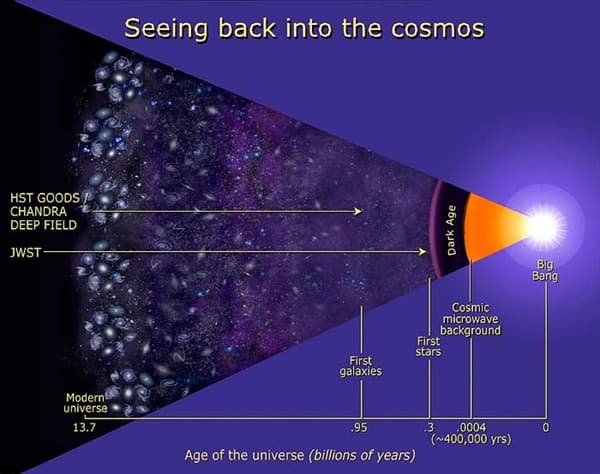
The case for a cosmic beginning does not rest on one discovery alone. Rather, it emerges from several converging lines of evidence in modern cosmology, including the universe’s expansion, the cosmic microwave background, thermodynamic considerations, large-scale structure, and the implications of general relativity.
Together, these point away from an eternal steady-state universe and toward a cosmos with a finite past. From here, the key point is simple: the universe appears to have a beginning, and that fact is philosophically significant.
🧠 Why a Beginning Matters Philosophically
A universe with a beginning is not merely a scientific curiosity, but rather raises a deeper metaphysical question.
If space, time, matter, and energy began to exist, then the cause of the universe cannot itself be made of matter, located in space, or bound by time in the ordinary physical sense. Whatever brought the universe into being would have to be beyond the physical system it caused.
This does not by itself prove the God of the Bible, but it does make a transcendent cause much more compelling than it appeared when people assumed the universe was eternal.
This is where the debate becomes more focused: Naturalism seeks to explain reality without appeal to any mind or cause beyond nature itself. But if nature had a beginning, then nature itself is not self-explanatory: something deeper must account for it.
One naturalistic response is to say that the universe came from “nothing.” But that raises an immediate question: what exactly does “nothing” mean?
❓What Does “Nothing” Really Mean?
Popular discussions sometimes say that the universe came from “nothing.” But that word can be misleading.
In the strictest sense, nothing means the absence of anything at all: no matter, no energy, no fields, no laws, no space, no time.
In many naturalistic accounts, however, “nothing” does not mean absolute non-being.2 It may refer instead to a quantum vacuum, an underlying field, or a deeper law-governed framework out of which universes can emerge.
But that is not nothing in the strict sense; it is already something.
For that reason, the central question remains in place: why does that underlying reality exist at all? Even when the problem is pushed back a level with alternative theories, it has not been solved, only relocated.
That is the point behind the article’s title. The phrase is provocative, but the question it raises is genuine: if the universe did not arise from absolute nothing, what is the ultimate source of the reality from which it came?
🎯 Fine-Tuning and the Order of the Cosmos
The question of origins also leads naturally to the question of order. Once the universe is understood as having a beginning, the next issue is why its basic structure appears so unusually fit for stable matter, chemistry, stars, and life.
A number of features of the cosmos appear to fall within narrow ranges that make a life-permitting universe possible. Gravity, the cosmological constant, the strong nuclear force, and the low-entropy condition of the early universe are among the most frequently discussed examples.3,4 How much weight this carries is itself debated, and some physicists argue the life-permitting ranges are wider than commonly claimed.3
Fine-tuning is not a mathematical proof of theism, but it sharpens the question. The more the universe appears contingent, intelligible, and delicately balanced, the harder it becomes to treat that order as the product of blind process alone.
For that reason, fine-tuning strengthens the larger case developed in this article. The question is no longer only why anything exists, but why reality is ordered in a way that allows complexity, stability, and life.
⚖️ Which Worldview Better Fits the Evidence?
Some will point to quantum cosmology, multiverse proposals, or other speculative extensions as possible naturalistic accounts of cosmic origins.3,5 Some physicists and cosmologists find these approaches promising because they offer ways to push the ultimate origin question back to a deeper physical framework. Those ideas are worth acknowledging, especially because cosmology remains an active field with real open questions. At the same time, quantum cosmology still has no unique or completely well-defined formulation,5 and multiverse proposals have been criticized as speculative and difficult to test.4 Neither carries the breadth of empirical support behind the hot Big Bang framework.1
The central issue, then, is not what might someday be possible in principle. It is what best explains the data we actually have now. Modern cosmology points to a universe with a finite past, intelligible laws, and a basic structure that falls within unusually narrow life-permitting ranges.
Furthermore, alternative models may try to place our universe within some wider framework, but that does not change the main explanatory question raised by the evidence itself. It simply moves the discussion to a deeper level: why does that wider reality exist, why does it have the character it does, and why is it capable of producing a universe like ours?
For that reason, the issue is not whether more elaborate naturalistic scenarios can be imagined. The issue is which worldview best accounts for the kind of universe modern science has actually uncovered.
📝 Conclusion
The point of this article is not that cosmology leads directly or inevitably to Christianity. Rather, the data we have — a universe with a finite beginning and deep, rational order — provide powerful support for a theistic framework. In that sense, the cosmos aligns ontologically with the God revealed in Scripture, echoing the opening declaration of Genesis 1:11 In the beginning, God created the heavens and the earth. that reality itself is contingent, ordered, and grounded in a transcendent mind.
That is why the phrase “the virgin birth of the universe” continues to resonate, even if rhetorically. The deeper point is that the universe does not look self-originating, self-explanatory, or indifferent to rational structure. It looks contingent, ordered, and in need of a cause beyond itself.
📚 References
K. A. Olive and J. A. Peacock, “Big-Bang Cosmology,” in Review of Particle Physics (Particle Data Group, revised August 2025).
Lawrence M. Krauss, “A Universe from Nothing: Why There Is Something Rather than Nothing” (New York: Free Press, 2012).
Simon Friederich, “Fine-Tuning,” Stanford Encyclopedia of Philosophy.
Luke A. Barnes, “The Fine-Tuning of the Universe for Life,” in The Routledge Companion to Philosophy of Physics (2021).
Martin Bojowald, “Quantum Cosmology: A Review,” Reports on Progress in Physics 78, no. 2 (2015): 023901.
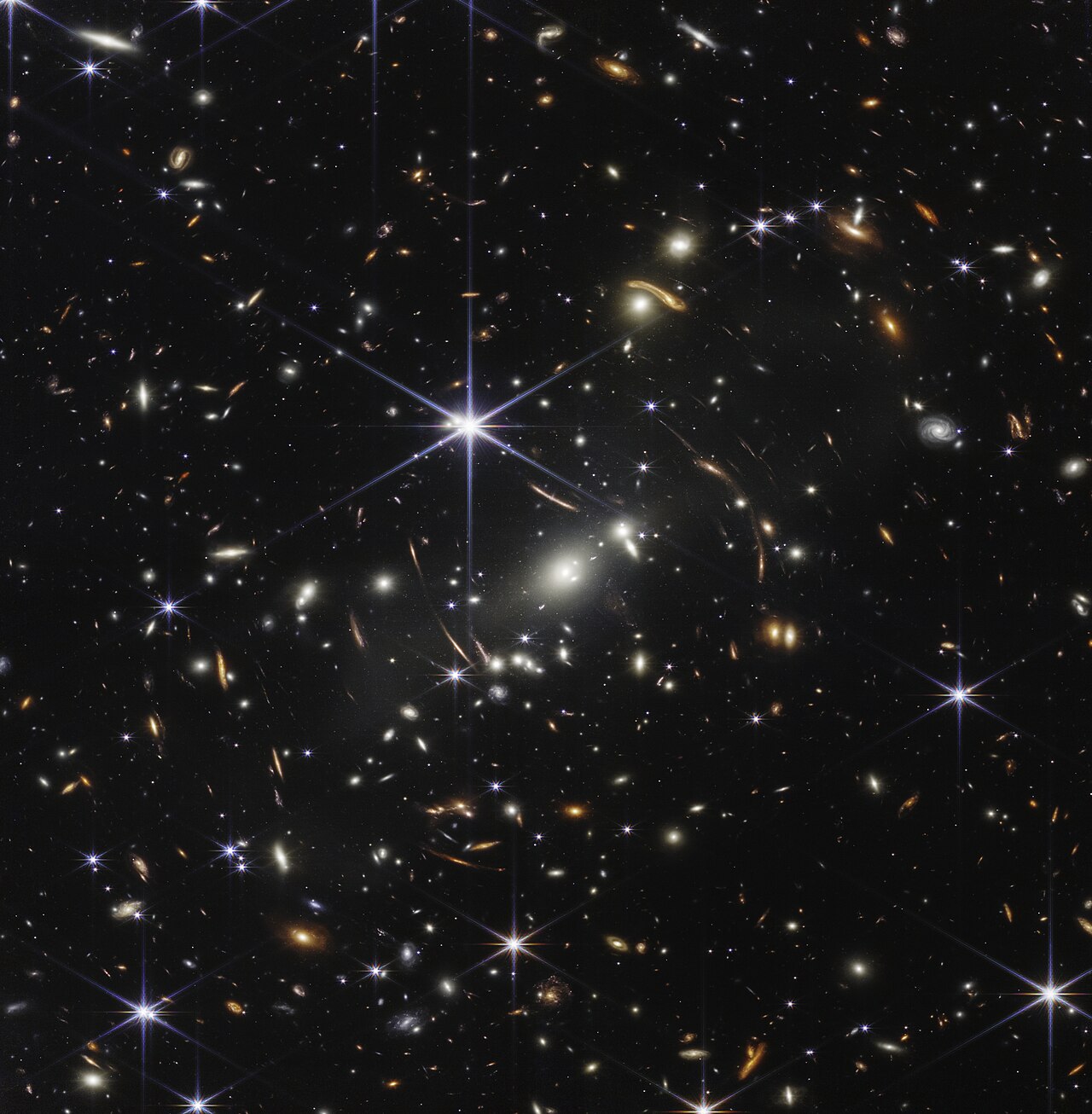
Image Credits: Webb’s First Deep Field (SMACS 0723), by NASA, ESA, CSA, and STScI, via Wikimedia Commons. Public domain with source credit required.
Comments
No comments yet. Be the first to share your thoughts.