
The Expanding Universe and the Case for a Cosmic Beginning
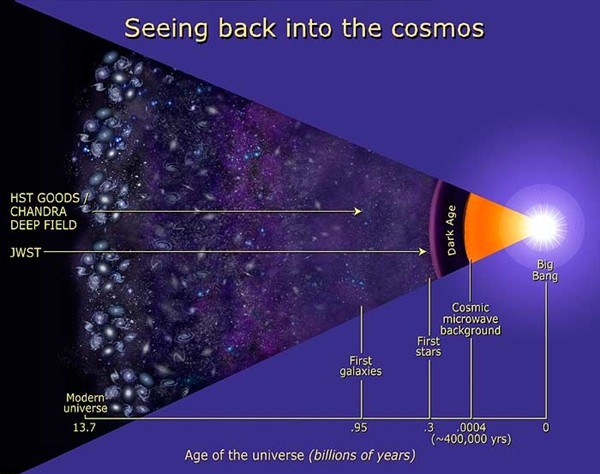
The expanding universe refers to the observation that space itself is expanding, causing distant galaxies to move away from one another over time. This was first established through observations of galactic redshift, which showed that light from distant galaxies is shifted toward the red end of the spectrum, indicating recession.1
This discovery changed the way scientists understood the cosmos. The universe was no longer viewed as static or eternal in the old steady-state sense, but as a dynamic system with a real history.2
🌌 What Expansion Means
A few basic points are important here:
- The universe is not expanding into preexisting empty space. Rather, space itself is expanding.
- On large scales, galaxies appear to recede from one another in a way that is consistent with this overall expansion.
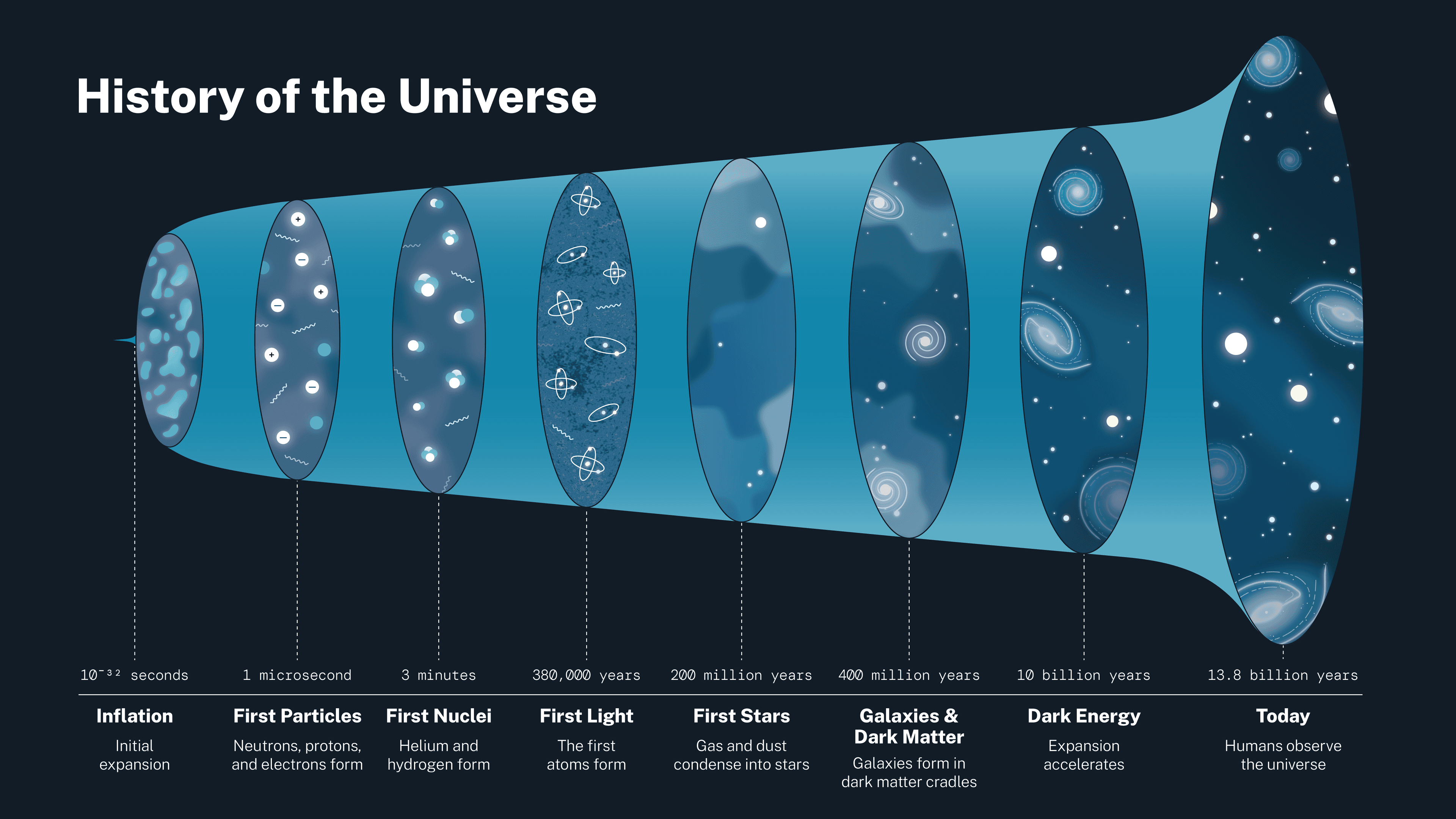
- When this expansion is traced backward, the universe appears to have been smaller, denser, and hotter in the past.
- Modern cosmology therefore describes the observable universe as having a finite age and an early hot, dense state.
Why Do Astronomers Say Space Is Expanding?
A simple way to picture this is the classic balloon analogy. If dots are placed on the surface of an inflating balloon, each dot moves farther away from the others as the surface expands. The dots are not flying outward from one special center on the surface itself; rather, the surface as a whole is stretching. The universe is not literally a balloon, of course, but the analogy helps show why astronomers say space is expanding, not that galaxies are racing through empty space from a single central point.
Mathematical Implications
This expansion also follows a broader pattern known as Hubble’s Law: the farther away a galaxy is, the faster it appears to recede. In simplified terms, recession velocity is approximately equal to the Hubble constant multiplied by distance. Astronomers measure very large distances in megaparsecs; one megaparsec equals about 3.26 million light-years. That means a galaxy one megaparsec away would recede at roughly 70 kilometers per second, while a galaxy twice as far away would recede at roughly twice that rate.3
This same mathematical equation also helps astronomers estimate the universe’s large-scale history. Because the expansion rate can be measured, it becomes possible to work backward and estimate how long the universe has been expanding (~13.8 Billion years)2
This is why the discovery of cosmic expansion was so important. It strongly suggested that the universe is not eternal or unchanging, but a cosmos with a measurable history.
🔍 What Expansion Tells Us About the Past
If the universe is expanding now, then it must have been smaller, denser, and hotter in the past. That is one of the central reasons the hot Big Bang model became so compelling.
Observations with the James Webb Space Telescope (JWST) have now confirmed galaxies at redshifts as high as 14.44 (such as the record-holder MoM-z14). This means we are seeing it as it existed ~280 million years after the Big Bang (when the universe was roughly 2% of its current age). These observations show how remarkably far back the effects of cosmic expansion can be directly traced today through the stretching of light.4
However, even these impressive views do not take us all the way back to the very first moment (often called t=0). There is still an earliest phase of cosmic history that lies beyond the reach of direct galaxy observations.4
Although physicists continue to debate the details of that very earliest phase, cosmic expansion remains one of the clearest indications that the cosmos has a real history and an early hot, dense beginning.
🧠 How This Supports the Broader Case for a Beginning
By itself, the expanding universe does not establish every part of the cosmological argument. But it does provide one foundational piece of the broader scientific case that the universe has a finite past.
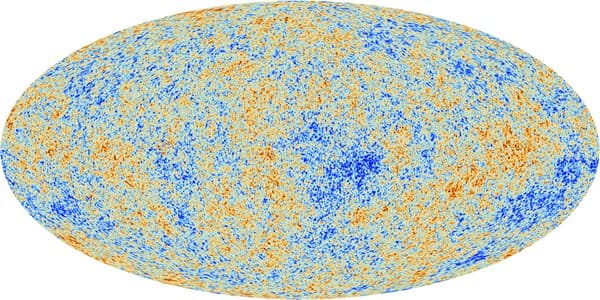
That is why it matters. Expansion undercuts the older idea of a static, eternal universe and points instead to a cosmos that has developed over time. In that sense, it is best understood as one major line of evidence in a wider cumulative case. Other lines of evidence, such as entropy and the cosmic microwave background, help fill out that picture in even greater detail.
🧪 A Brief Qualification
This does not mean every alternative model disappears and those models are discussed in their respective articles. Cosmologists still explore proposals involving inflation, cyclic models, and other attempts to describe the earliest stages of cosmic history. But those discussions do not remove the central significance of expansion itself. The mainstream cosmological picture still describes a universe with a real history, an early hot, dense state, and a finite observable age.2
📝 Conclusion
The discovery of the expanding universe marked a major turning point in modern science. It showed that the cosmos is not static or eternal in the way many once assumed, but has a real history that can be traced backward toward an early hot, dense state.
For that reason, cosmic expansion remains one foundational part of the broader scientific case that the universe has a finite past. It does not answer every philosophical or theological question on its own, but it does help build the larger cosmological argument that the universe began to exist.
📚 References
NASA Science — “Hubble Cosmological Redshift”
NASA Science — “Hubble Big Bang”; “Cosmic History”
NASA Science — “Hubble Constant and Tension”
NASA Science — “NASA Webb Pushes Boundaries of Observable Universe Closer to Big Bang”
Image Credits: Cosmic Timeline. NASA and Ann Feild (STScI), via NASA Science.
Comments
No comments yet. Be the first to share your thoughts.