The Second Law of Thermodynamics and the Universe’s Low-Entropy Beginning
The Second Law of Thermodynamics states that, in an isolated system, entropy tends to increase over time. In popular explanations, entropy is often described as a measure of disorder, though the concept is more precise in physics. At a basic level, the law means that usable energy becomes less available over time, and systems naturally move toward thermodynamic equilibrium.1
Applied to the universe as a whole, this raises an important question: if entropy increases over time, why did the universe begin in such a highly ordered, low-entropy state?
🌌 What the Second Law Suggests About the Universe
Cosmologists often treat the universe, or large regions of it, as effectively isolated, though gravity and cosmic expansion make the details more subtle than in simple lab examples.1 Even with those qualifications, applying the Second Law to the cosmos suggests several important things:
- The universe has a real thermodynamic history.
- Entropy has been increasing over cosmic time.
- The early universe must have been in a very low-entropy condition compared to what followed.3
This matters because the universe is not in a state of thermodynamic exhaustion. It still contains usable energy, structured systems, and ongoing physical processes. That reality naturally raises the question of why the cosmos began in such a special condition.
💥 The Puzzle of the Universe’s Low-Entropy Beginning
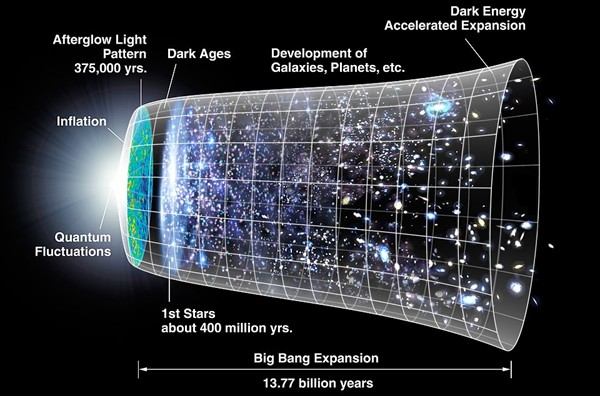
The standard Big Bang model describes the early universe as a hot, dense state.2
Yet one of the deepest questions in modern cosmology is why that early state was also so extraordinarily low in entropy, especially in gravitational terms.3
Nobel Prize-winning physicist Roger Penrose famously emphasized just how special the universe’s initial condition appears to have been. In discussing the early universe, Penrose argued that the fraction of relevant phase space corresponding to such an initial condition was extraordinarily tiny, often summarized as about 1 in 10^10^123. The point is not that this number gives us a complete theory of origins, but that the universe’s low-entropy beginning was not a generic or unsurprising starting point. It was a profound discovery that calls for explanation3
That is one reason the Second Law is so important in discussions of cosmic origins. If entropy increases over time, then the universe appears to have started in a condition far from thermodynamic equilibrium.
🧠 How This Connects to the Question of a Beginning
The Second Law is not merely a philosophical or theological talking point. It fits squarely within the standard cosmological picture: the universe has a real thermodynamic history, entropy has increased over time, and the early universe was in a much lower-entropy state than the one we observe today.3
That matters because, if the universe had existed forever in a simple past-eternal sense while entropy continually increased, one would expect it to have already reached thermodynamic equilibrium, sometimes called “heat death.” Yet the universe still contains usable energy, large-scale structure, and ongoing physical processes.1
For that reason, the Second Law is best understood as one foundational line of scientific support in the broader case that the universe has a finite thermodynamic past rather than an infinite one.
✨ What the Second Law Does and Does Not Show
The Second Law is highly relevant to the question of cosmic origins, but it should be stated carefully.
It does show that the universe has a real thermodynamic history and that its low-entropy beginning calls for explanation. It also supports the mainstream picture of a cosmos that has not existed forever in a state of equilibrium, but has developed over time from a very different initial condition.3
It does not, by itself, prove that God exists or establish every step of a cosmological argument. Moving from thermodynamics to a transcendent cause is a philosophical inference, not a direct result of physics alone.
Still, the law remains one important scientific strand in the broader cumulative case for a cosmic beginning. It serves as a piece of evidence and strengthens the wider conclusion that the universe has a finite past and is not an eternal, self-explanatory system.
🧪 Naturalistic Responses
The Second Law strongly supports the standard picture of a universe with a real thermodynamic history, but that does not mean every thinker agrees on how best to explain that history or its starting conditions.
Some naturalistic proposals attempt to account for the universe’s low-entropy beginning within a larger physical framework. One example is the multiverse, in which our universe is only one of many cosmic domains with differing initial conditions. On this view, a low-entropy universe like ours may be improbable in isolation but less surprising across a vast enough ensemble.4
Others appeal to quantum cosmology, suggesting that the universe may arise from an underlying quantum state or vacuum framework. These models aim to explain cosmic origins in terms of physical processes rather than divine agency.5
Nevertheless, such proposals do not remove the central issue raised by the Second Law. They attempt to explain the universe’s thermodynamic history within a wider model, but they still leave open the deeper question of why that larger framework exists and why it gives rise to a universe with such a low-entropy beginning.
📝 Conclusion
The Second Law of Thermodynamics remains one of the most important scientific principles brought into discussions of cosmic origins. It points to a universe with a real thermodynamic history, increasing entropy over time, and an early state that was radically different from the one we observe today.3
All of this makes the Second Law one foundational piece of the broader scientific case that the universe has a finite past. It does not answer every philosophical or theological question on its own, but it does help build the larger cosmological argument that the universe had a beginning and therefore calls for an explanation beyond itself.
📚 References
Penrose, R. (2010). Cycles of Time: An Extraordinary New View of the Universe. Bodley Head.
Friederich, S. (2021). “Introduction.” In Multiverse Theories: A Philosophical Perspective. Cambridge University Press.
Bojowald, M. (2015). “Quantum cosmology: a review.”
Image Credits: History of the Universe (WMAP). NASA / WMAP Science Team via Wikimedia Commons. Public domain.
Comments
No comments yet. Be the first to share your thoughts.