
Einstein’s General Relativity: Scientific Shift Toward a Cosmic Beginning
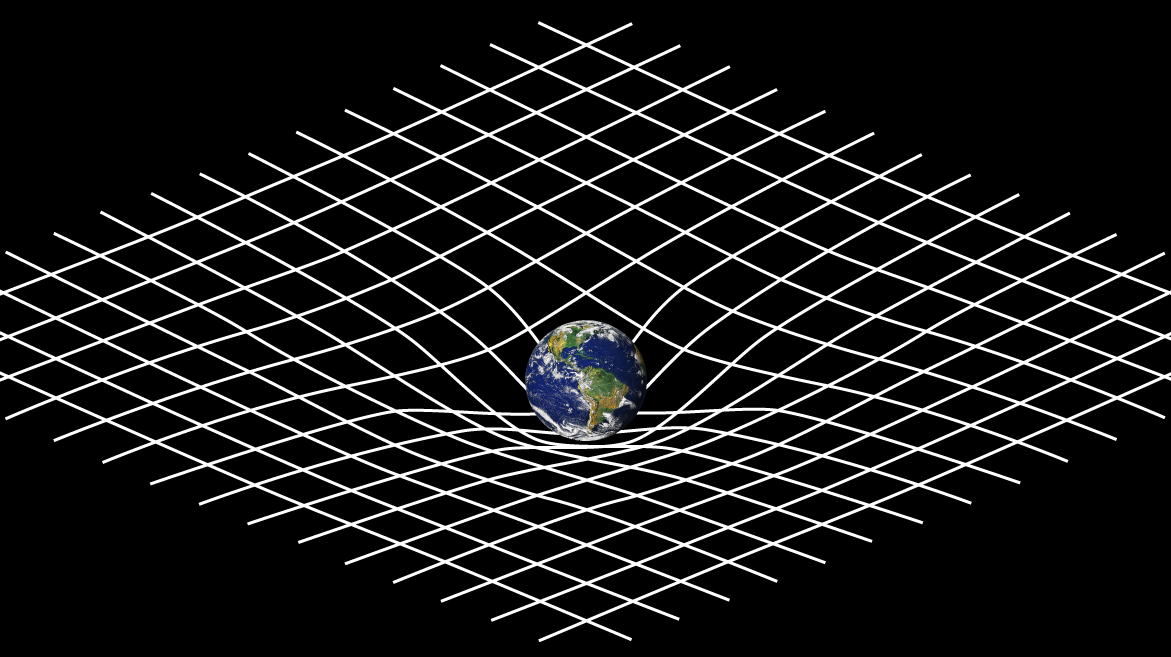
When Albert Einstein developed his General Theory of Relativity in 1915, he thought he was discovering a better way to describe how gravity works. But his equations pointed to something much bigger: the universe was not fixed and eternal, but dynamic and marked by a real history.1 In broad terms, this helped pave the way for the modern picture of the Big Bang and, ultimately, for the idea that:
Time, space, and matter began together at the Big Bang.
This was far more than a minor tweak in our understanding of gravity. Einstein’s equations quietly overturned the long-held assumption of an eternal, unchanging universe and opened the door to something modern science had long resisted: a real beginning.2
🌀 What Is Einstein's General Relativity?
General relativity says that gravity is not just an invisible force pulling objects together. Instead, space and time are woven together into one connected reality called spacetime. You can think of spacetime as the “arena” in which everything in the universe exists and happens.
Einstein’s key insight was that this spacetime is not rigid or fixed. Matter and energy affect it. A simple way to picture this is to imagine placing a heavy ball on a stretched sheet: the sheet bends, and smaller objects roll toward it. In a similar way, massive objects like stars and planets bend spacetime, and that bending is what we experience as gravity.
That flexibility is significant because the universe is not just a static stage where events unfold: the stage itself can change. Space can expand, time is bound up with that structure, and the overall shape of the universe can evolve. In that sense, general relativity made it scientifically natural to think of the universe as something with a real history rather than an eternal, unchanging backdrop.1
🌌 Why This Changed Cosmology
When scientists applied Einstein’s equations to the universe as a whole, they found that a static and eternal universe was not the natural outcome. Einstein resisted that implication because the observational evidence available in his time did not yet point to an expanding universe, and he introduced the cosmological constant (Λ) in an effort to preserve a static cosmos.2
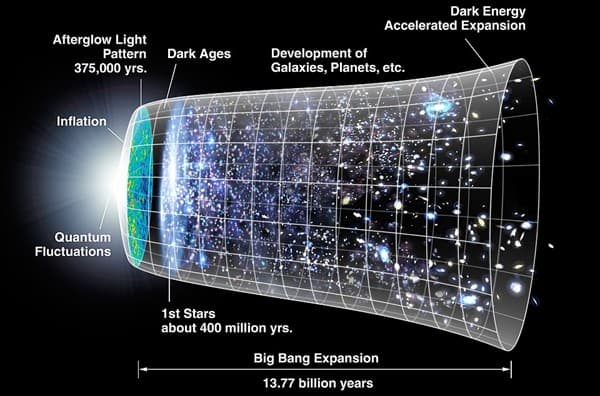
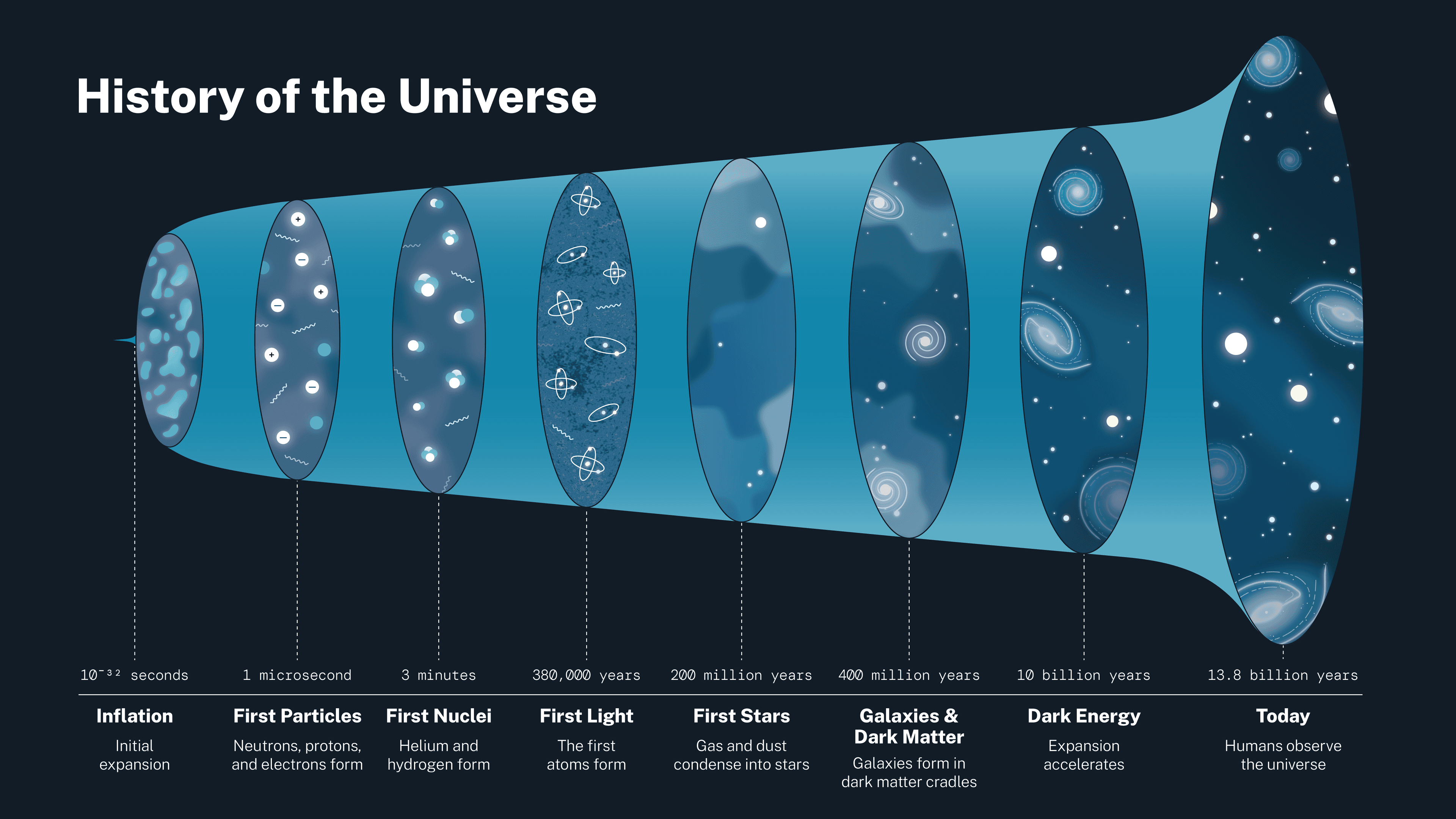
However, once expansion was later observed, as discussed more fully in our Expanding Universe article, the dynamic universe described by general relativity became part of the modern scientific consensus known as Big Bang cosmology, replacing the older picture of a fixed, eternal universe.
🧩 A Later Reinforcement
Later work in cosmology strengthened this picture further. The Borde-Guth-Vilenkin theorem showed that any universe that has, on average, been expanding throughout its history cannot be extended indefinitely into the past, but is past-incomplete. This theorem reinforces the broader conclusion that a simple past-eternal universe is difficult to maintain.3
Its authors read the result differently, though not with equal force. Vilenkin, an agnostic with no theological stake in the outcome, argues that the theorem leaves cosmologists no escape from a beginning. Alan Guth, whose work centers on eternal inflation, has stated publicly that the universe probably did not have a beginning and is very likely eternal.4 Guth does not dispute what the theorem proves. He accepts the result and still expects a past-eternal universe, which is a position held alongside the theorem rather than drawn from it. That is an expectation about where the science may go, not a reading of where the evidence currently points: toward a beginning.
In the words of Vilenkin:
“It is said that an argument is what convinces reasonable men and a proof is what it takes to convince even an unreasonable man. With the proof now in place, cosmologists can no longer hide behind the possibility of a past-eternal universe. There is no escape: they have to face the problem of a cosmic beginning.” — Many Worlds in One, p. 1765
⚛️ A Brief Quantum Qualification
As discussed in the other cosmological articles, physicists still debate how best to describe the universe’s earliest moments, especially the potential implications of quantum gravity. Some proposals attempt to soften the classical singularity or describe a deeper framework underlying the early universe.
However, these open questions do not restore the older idea of a static, eternal cosmos. Even leading eternal-inflation and emergent-universe models run into a beginning problem. The issue, then, is not whether the universe simply existed forever in its present form, but how its beginning is best understood.6
🧭 Where This Leads
Even Vilenkin, an agnostic cosmologist, has been careful to say that his theorem does not “prove anything one way or another” about God.7 Yet he recognizes that the scientific landscape has changed decisively. Cosmologists can no longer treat the universe as eternal, undermining one of the oldest naturalistic assumptions.
Vilenkin has acknowledged that a beginning is uncomfortable for many physicists because it suggests some cause outside the universe. He has explored quantum models in which the universe might spontaneously appear through quantum tunneling from “nothing.” However, even in these proposals, he is clear that the laws of physics are still required, and in his words they “are definitely not nothing.”7
Furthermore, these quantum creation scenarios remain speculative and are far from scientific consensus. More importantly, they do not eliminate the beginning; they only attempt to describe how it might have occurred. This leaves the deeper question standing: what best explains the origin of the laws and mechanisms of quantum mechanics themselves?
📝 Conclusion
General relativity did not settle every question by itself, but it laid the essential scientific groundwork for a universe with a real history and a definite beginning. Later developments in cosmology, including the Borde-Guth-Vilenkin theorem, have only reinforced this picture. Despite ongoing efforts in quantum gravity and multiverse proposals, no model has restored the older vision of a past-eternal, self-existing cosmos.
Once we recognize this shift, the central question moves beyond science alone: what best explains the origin of space, time, matter, and the finely tuned laws that govern them?
While science can identify the need for a beginning, it cannot by itself identify the nature of the cause. For Christians, however, this scientific development carries profound resonance. The case for a cosmic beginning aligns powerfully with the opening declaration of Scripture: “In the beginning, God created the heavens and the earth.” The universe did not emerge from absolute nothingness on its own, nor did it exist eternally by necessity. Rather, it was brought into being by the uncaused first cause: a transcendent reality outside of space, matter, and time itself.
📚 References
Sean Carroll — “Post-Debate Reflections” (2014), reporting Alan Guth’s stated view.
Vilenkin, Alexander — Many Worlds in One: The Search for Other Universes New York: Hill and Wang, 2006.
Mithani and Vilenkin — “Did the Universe Have a Beginning?” (2012).
Image Credits: Spacetime curvature illustration via NASA Blueshift / NASA Goddard Space Flight Center, sourced from NASA. Reused with source credit under NASA media usage guidance: NASA Science multimedia policy.
Comments
No comments yet. Be the first to share your thoughts.