
Cosmological Argument
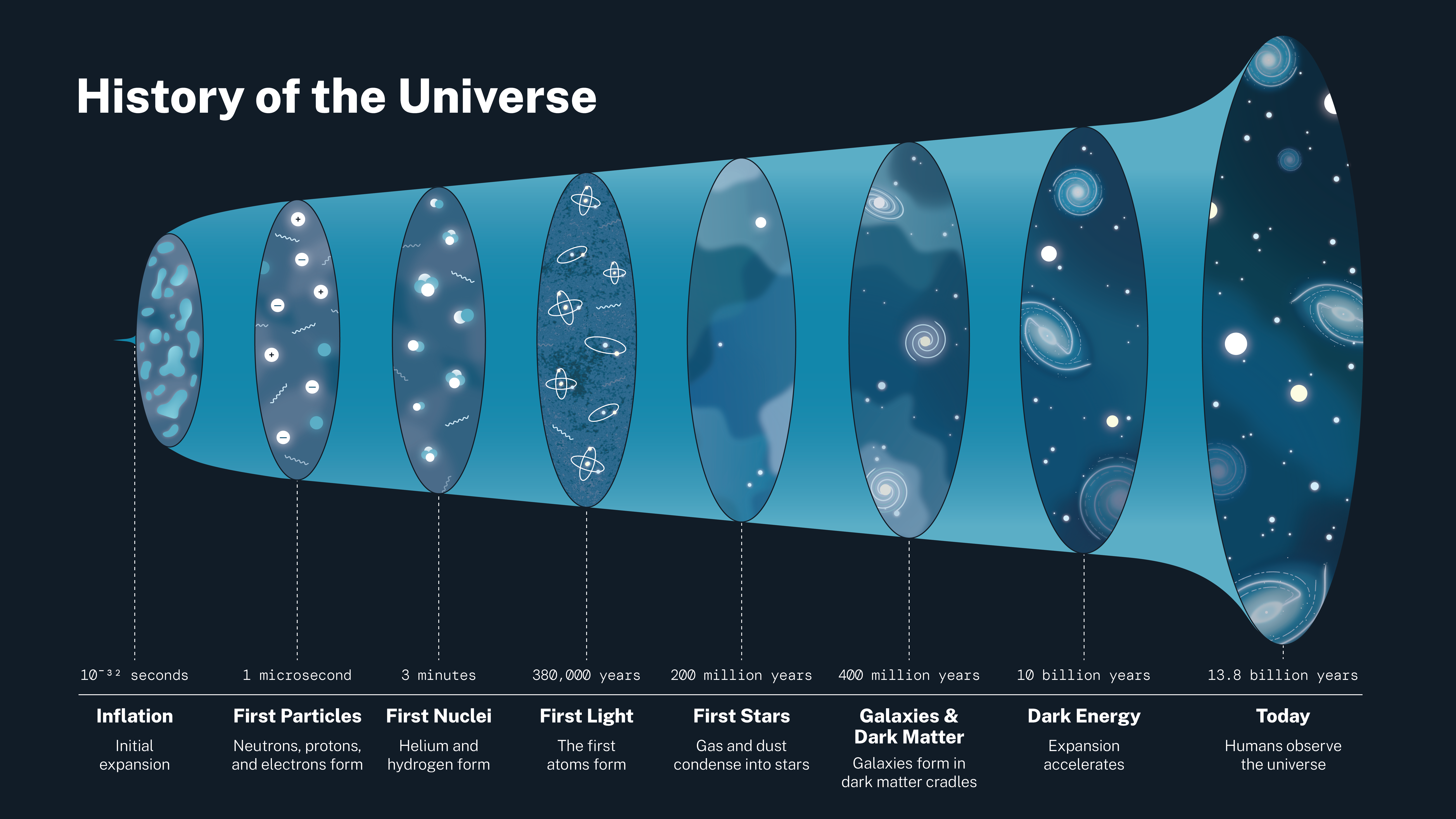
One of the most important things to understand about the cosmological argument is that it does not begin with a religious text, church tradition, or a prior commitment to theism. It begins with the modern scientific consensus that the universe had a beginning.
According to the most widely accepted scientific view today, the universe had a real beginning nearly 14 billion years ago.1 It began in an extremely hot, dense state and has been expanding ever since. This is the basic framework modern cosmology uses to understand the history of the universe. Rather than viewing the universe as eternal and unchanging in the past, modern science sees it as having a genuine beginning.3
That is what makes the cosmological argument powerful. It is not an appeal to ancient mythology or a “God of the gaps” move built on scientific ignorance. Instead, it reasons from what modern cosmology appears to indicate: that the universe has a finite past. In its most basic form, the argument runs as follows:
-
The universe had a beginning.
-
Anything that begins to exist must have a cause.
-
Therefore, the universe must have a cause.
The force of the argument lies in the first premise. That premise is not merely theological. It is deeply connected to the modern scientific understanding of the cosmos. This article offers a high-level overview of that case, with future articles exploring each major line of evidence, objection, and alternative model in greater detail.
🌌 Modern Cosmology and the Beginning of the Universe
The case that the universe had a beginning rests on several major features of modern cosmology. For ease of memory, many apologists such as Frank Turek summarize them with the acronym S.U.R.G.E.8:
| Letter | Evidence | Explanation |
|---|---|---|
| S | Second Law of Thermodynamics | The universe is running out of usable energy, indicating it hasn’t existed forever.7 |
| U | Universe is Expanding | Discovered by Edwin Hubble; galaxies are moving apart from one another.2 |
| R | Radiation Afterglow | The cosmic microwave background is leftover heat from the universe’s origin.3 |
| G | Great Galaxy Seeds | Slight temperature variations in the background radiation show early structure formation.5 |
| E | Einstein’s General Relativity | Time and space are bound together in a single physical framework, pointing to a real cosmic beginning.6 |
Taken together, these are not merely talking points used by theists. They reflect some of the main reasons modern cosmology holds that the universe had a real beginning in a hot, dense early state rather than existing eternally in the past.3
🧠 Why This Matters for the Cosmological Argument
Once that first step is in place, the question becomes unavoidable: if the universe began to exist, what explains its beginning?
This is where the cosmological argument moves from science to philosophy. Science can describe the universe’s early history with remarkable precision. It can trace expansion, map the cosmic microwave background, and estimate the universe’s age. But science does not remove the deeper explanatory question. It sharpens it.
If the universe began to exist, then it is reasonable to ask why it exists at all rather than not existing, and what accounts for the transition from no universe to universe. The cosmological argument contends that the best explanation is not that the universe somehow caused itself, nor that it simply appeared without cause, but that it depends on a cause beyond itself.
That is why the argument remains so compelling. The data do not point to an eternal material cosmos. They point to a universe with a beginning. And once a beginning is granted, the need for explanation follows naturally.
✨ What Sort of Cause Would This Have to Be?
If the universe includes all physical reality—space, time, matter, and energy—then the cause of the universe cannot simply be another object or force inside the universe. It must be of a fundamentally different order.
That is why many philosophers and Christian thinkers argue that the cause of the universe would have to be:
- beyond space, because space is part of the universe that began
- beyond time, because cosmic time belongs to the history of the universe
- immaterial, because matter and energy are part of the physical order that came into being
- immensely powerful, because the cause would have to account for the existence of the entire cosmos
This is not a retreat from science. It is an inference from what science says about the universe’s beginning. If the universe is not eternal, then its explanation cannot ultimately lie in the universe itself.
🤔 Why Many Theists Also Argue for an Intelligent, Personal Cause
At this point, some stop at the idea of a transcendent first cause. Others go further and argue that this cause is best understood as personal, not impersonal.
The basic reasoning is fairly simple. Impersonal forces and laws of nature explain how things happen within the universe. Gravity explains attraction. Radiation explains certain physical effects. Natural laws describe how the universe operates once it already exists. But the cosmological argument is asking a deeper question: what explains the universe itself coming into existence?
If time, space, matter, and energy all began with the universe, then its cause cannot be just another physical process inside it. It cannot be one more part of nature, because nature itself is what needs to be explained.
For that reason, many theists argue that the cause is better understood as a personal agent—one capable of willing and initiating the universe’s existence. Physical processes can explain what happens within the universe, but they do not explain the origin of the universe itself. A personal cause, by contrast, is argued to make better sense of the universe’s beginning than a blind, impersonal mechanism.
That conclusion goes beyond what cosmology alone can prove, but it is not arbitrary. It is an attempt to follow the logic of the argument one step further: if the universe had a beginning, and if its cause lies beyond the physical order, then many contend that a personal cause is a far better explanation.
🛡️ Addressing a Common Objection
A skeptic may object that cosmology does not yet answer every question. That is true. The standard Big-Bang model is highly successful, but even mainstream cosmology recognizes open questions surrounding inflation and the earliest moments of cosmic history.4 Some therefore appeal to inflationary models, quantum cosmology, or multiverse proposals as alternatives to a transcendent cause. These alternative proposals deserve a closer examination and will be addressed in future articles, but they do not remove the need for explanation. At most, they push the question back a level: why does that larger framework exist, and why does it produce a universe with a finite beginning at all?
Modern cosmology no longer points to an eternal universe, but a universe with a finite cosmic past.4 The cosmological argument starts there and asks what best explains that fact.
The strength of the argument lies not in what science cannot explain, but in what science has made increasingly clear: the universe began to exist.1
📝 Conclusion
The cosmological argument matters because it starts with a fact modern science has made increasingly difficult to deny: the universe had a beginning.
The expansion of the universe, the cosmic microwave background, the measured age of the cosmos, and the broader framework of modern cosmology all point back to the same reality.1 The universe is not an eternal backdrop that has always been here. It has a history. It has a beginning. And beginnings demand explanation.
That is why the cosmological argument remains so compelling. Once the universe is understood as something that began to exist, the question is no longer whether an explanation is needed, but what kind of explanation is adequate. The argument answers that the universe cannot be its own ultimate explanation. Its cause must lie beyond it.
The universe had a beginning, and beginnings do not explain themselves. That is why the cosmological argument still carries such weight.
📚 References
NASA Science — Hubble Big Bang
NASA Science — Hubble Cosmological Redshift
NASA Science — The Big Bang
NASA Science — Overview
NASA Science — WMAP Overview
LIGO Lab — What are Gravitational Waves?
NIST — Remarks on Irreversible Processes and Entropy Increase
CrossExamined.org — Does God Exist?
Image Credits: History of the Universe. NASA Science via NASA.
📚 SURGE Articles
🔗 Second Law of Thermodynamics: Why Entropy Implies a Beginning
🔗 Radiation Afterglow: The Echo of a Beginning
🔗 Galaxy Seeding: The Blueprint for a Habitable Cosmos
🔗 Einstein’s General Relativity: Time Had a Beginning
Comments
No comments yet. Be the first to share your thoughts.