
The Cyrus Cylinder
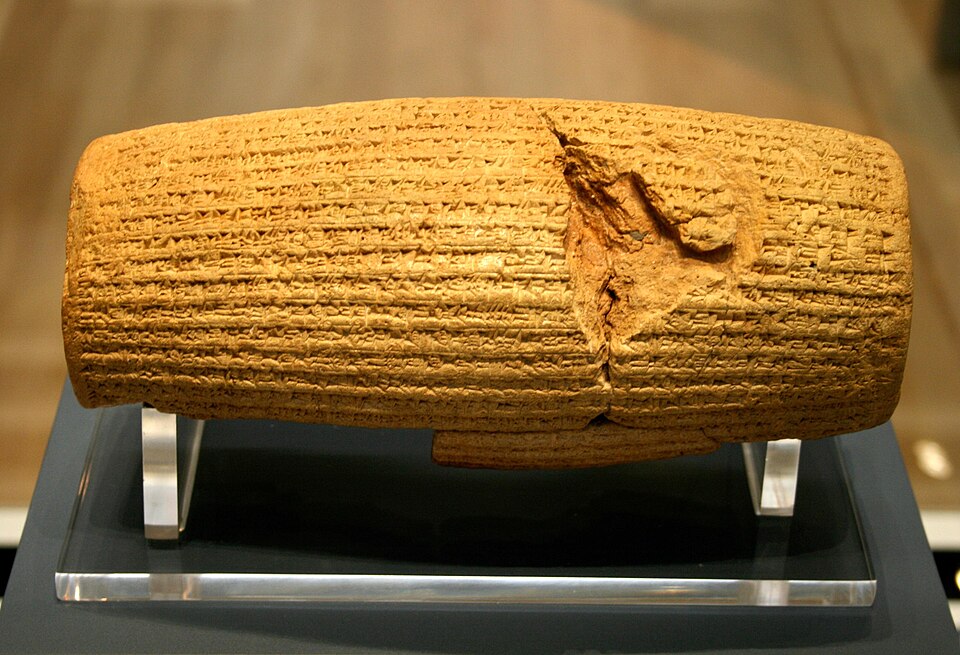
The Cyrus Cylinder is a clay artifact dated to 539 BC that records Cyrus’s Babylonian program of restoring sanctuaries, returning displaced cultic images, and resettling peoples.1 These policies form a valuable historical parallel to the return described in Ezra and 2 Chronicles. The artifact does not, however, mention Jerusalem, Judah, the Judean exiles, or Daniel 9’s starting decree. Its contribution to Daniel 9 is indirect but important: it shows that the biblical restoration setting fits known Persian imperial practice.
🧭 Historical Context
After capturing Babylon in 539 BC, Cyrus II sought to distinguish his rule from earlier Babylonian kings, who were remembered for temple destruction, forced deportations, and religious suppression. His rule, by contrast, emphasized political stability through the restoration of local religious institutions and the repatriation of displaced populations.1 This strategy helped secure loyalty among newly conquered peoples and reduced the likelihood of rebellion.
These policies included:
-
Restoration of damaged or neglected temples
-
Return of cultic images or sacred property
-
Repatriation of displaced peoples to their homelands
-
Promotion of imperial stability through religious tolerance
📜 The Cyrus Cylinder and Repatriation Policy
The clearest evidence for this policy appears in the Cylinder’s so-called “repatriation section,” which describes the return of both deities and populations to their original locations. Lines 30–32 state:
"From [Shuanna] I sent back to their places to the city of Ashur and Susa, Akkad, the land of Eshnunna, the city of Zamban, the city of Meturnu, Der, as far as the border of the land of Guti—the sanctuaries across the river Tigris—whose shrines had earlier become dilapidated, the gods who lived therein, and made permanent sanctuaries for them. I collected together all of their people and returned them to their settlements..."2
This passage demonstrates a coordinated imperial effort to reverse earlier deportations and restore religious infrastructure throughout the region.
📖 Relationship to the Bible
In this historical context, the biblical claim that Cyrus authorized the return of Jewish exiles and the rebuilding of the Jerusalem Temple aligns closely with known Persian practice.
The Cyrus Cylinder, alongside broader Persian administrative evidence, shows that restoration of sanctuaries and displaced communities was compatible with Cyrus’s imperial program. This wider policy is further illuminated by Persian-period records, the Elephantine papyri3, and the continuation of temple restoration under Darius I.4 Ezra 1:1–41 In the first year of Cyrus king of Persia, that the word of the Lord by the mouth of Jeremiah might be fulfilled, the Lord stirred up the spirit of Cyrus king of Persia, so that he made a proclamation throughout all his kingdom and also put it in writing: 2 “Thus says Cyrus king of Persia: The Lord, the God of heaven, has given me all the kingdoms of the earth, and he has charged me to build him a house at Jerusalem, which is in Judah. and 2 Chronicles 36:22–2322 Now in the first year of Cyrus king of Persia, that the word of the Lord by the mouth of Jeremiah might be fulfilled, the Lord stirred up the spirit of Cyrus king of Persia, so that he made a proclamation throughout all his kingdom and also put it in writing: 23 “Thus says Cyrus king of Persia, ‘The Lord, the God of heaven, has given me all the kingdoms of the earth, and he has charged me to build him a house at Jerusalem, which is in Judah. Whoever is among you of all his people, may the Lord his God be with him. Let him go up.’” therefore describe the kind of localized authorization that is historically credible within the Persian period.
2 Chronicles 36:22–2322 Now in the first year of Cyrus king of Persia, that the word of the Lord by the mouth of Jeremiah might be fulfilled, the Lord stirred up the spirit of Cyrus king of Persia, so that he made a proclamation throughout all his kingdom and also put it in writing: 23 “Thus says Cyrus king of Persia, ‘The Lord, the God of heaven, has given me all the kingdoms of the earth, and he has charged me to build him a house at Jerusalem, which is in Judah. Whoever is among you of all his people, may the Lord his God be with him. Let him go up.’” states:
22 Now in the first year of Cyrus king of Persia, that the word of the LORD by the mouth of Jeremiah might be fulfilled, the LORD stirred up the spirit of Cyrus king of Persia, so that he made a proclamation throughout all his kingdom and also put it in writing:
23 “Thus says Cyrus king of Persia, ‘The LORD, the God of heaven, has given me all the kingdoms of the earth, and he has charged me to build him a house at Jerusalem, which is in Judah. Whoever is among you of all his people, may the LORD his God be with him. Let him go up.’”
Although the Cyrus Cylinder does not mention Jerusalem or Judah specifically, it confirms that such decrees were consistent with Persian imperial policy rather than an isolated or implausible claim unique to the biblical tradition.
✨ Theological Framing
Localized Decrees
One of the most significant points of comparison between the Cyrus Cylinder and the biblical texts lies in how Cyrus’s authority is theologically interpreted. When analyzing localized Persian decrees, scholars observe that the administrative action remains consistent, while the religious framing adapts to the audience being addressed.
-
The Babylonian Version: On the Cyrus Cylinder, the god Marduk is credited with selecting Cyrus to restore order and justice to Babylon.
-
The Biblical Version: In Ezra 1:22 “Thus says Cyrus king of Persia: The Lord, the God of heaven, has given me all the kingdoms of the earth, and he has charged me to build him a house at Jerusalem, which is in Judah., Isaiah 44:2828 who says of Cyrus, ‘He is my shepherd, and he shall fulfill all my purpose’; saying of Jerusalem, ‘She shall be built,’ and of the temple, ‘Your foundation shall be laid.’”, and Isaiah 45:11 Thus says the Lord to his anointed, to Cyrus, whose right hand I have grasped, to subdue nations before him and to loose the belts of kings, to open doors before him that gates may not be closed:, the God of Israel is identified as the one who appointed Cyrus as His “shepherd” and “anointed,” the instrument of restoration.
This pattern suggests that multiple versions of Cyrus’s proclamations likely circulated, each expressed in the religious language appropriate to a given community. The Cylinder reflects a Babylonian theological framework, while the biblical text preserves the version meaningful to the Jewish exiles.
| Point of Comparison | Cyrus Cylinder (Babylonian) | Book of Ezra (Biblical) |
|---|---|---|
| Supreme Deity | Marduk | Yahweh (The LORD) |
| The Mandate | "He [Marduk] took the hand of Cyrus" | "The LORD… has charged me" |
| The Injustice | Neglect of Babylonian cults | Destruction of Jerusalem Temple |
| Restoration | Return of Idols/Statues | Return of Temple Vessels |
| The Request | Gods ask Bel and Nabu for Cyrus’s long life | Pray for the life of the king and his sons |
One of the strongest links between the two texts is the request for prayer. Near the end of the Cylinder, Cyrus asks the gods he restored to pray daily for his long life. In Ezra 6:1010 that they may offer pleasing sacrifices to the God of heaven and pray for the life of the king and his sons., Darius, a later Persian king, pays for the Temple’s sacrifices so that its priests will “pray for the life of the king and his sons.” An independent Babylonian text and the biblical record describe the same royal practice, which is exactly what we would expect if Ezra preserves a genuine Persian decree rather than a later invention.
Sacred Property Convergence
A further point of convergence between the Cyrus Cylinder and the biblical account concerns the restoration of sacred property. The Cylinder emphasizes the return of divine images to their sanctuaries, while the biblical narrative highlights the return of temple vessels rather than idols:
“Cyrus the king also brought out the vessels of the house of the LORD that Nebuchadnezzar had carried away from Jerusalem and placed in the house of his gods.” (Ezra 1:77 Cyrus the king also brought out the vessels of the house of the Lord that Nebuchadnezzar had carried away from Jerusalem and placed in the house of his gods.)
This difference reflects a key cultural distinction. Because Israelite religion was aniconic and prohibited physical representations of God, there were no statues to restore. In this context, the gold and silver vessels taken from the Jerusalem Temple functioned as the cultic equivalent of the idols mentioned on the Cylinder. Their return aligns closely with the Persian policy of restoring the religious life of displaced peoples.
🌟 Daniel 9 and the Persian Restoration Context
The Cylinder provides historical context for the Persian restoration era behind Daniel 9, but it is not a copy of Daniel’s decree. Daniel 9:24–2724 “Seventy weeks are decreed about your people and your holy city, to finish the transgression, to put an end to sin, and to atone for iniquity, to bring in everlasting righteousness, to seal both vision and prophet, and to anoint a most holy place. 25 Know therefore and understand that from the going out of the word to restore and build Jerusalem to the coming of an anointed one, a prince, there shall be seven weeks. And for sixty-two weeks it shall be built again with squares and moat, but in a troubled time. describes seventy “weeks” (shavuim) beginning from a “word” to restore and rebuild Jerusalem. Interpreters disagree about which biblical authorization supplies that starting point.
Scholars often distinguish between the various stages of Persian authorization:
-
The Authorization of Cyrus (538/537 BC in the biblical account): Initiated the Judean return and rebuilding of the Temple. The Cylinder illustrates Cyrus’s broader policy but does not name this Judean authorization.
-
The Decree of Artaxerxes (457 BC): Gave Ezra broad authority to restore Jerusalem’s religious and civil life, from Temple worship to appointing judges (Ezra 7:11–2611 This is a copy of the letter that King Artaxerxes gave to Ezra the priest, the scribe, a man learned in matters of the commandments of the Lord and his statutes for Israel: 12 “Artaxerxes, king of kings, to Ezra the priest, the scribe of the Law of the God of heaven. Peace. And now). Many interpreters take this decree as the starting point of Daniel’s seventy weeks.
-
The Decree to Nehemiah (445/444 BC): Authorized the rebuilding of Jerusalem’s walls (Nehemiah 2:1–81 In the month of Nisan, in the twentieth year of King Artaxerxes, when wine was before him, I took up the wine and gave it to the king. Now I had not been sad in his presence. 2 And the king said to me, “Why is your face sad, seeing you are not sick? This is nothing but sadness of the heart.” Then I was very much afraid.). Others begin Daniel’s seventy weeks here.
The Cylinder shows that Persian rulers used restoration and repatriation as imperial policy, making Ezra’s setting historically intelligible. It does not identify which “word” should begin Daniel’s weeks, validate a particular 490-year calculation, or independently prove a messianic fulfillment. Its value is contextual: the prophecy is situated in a recognizable Persian-period world of royal authorizations, returns, temples, and rebuilt communities.
📌 Key Takeaways: Why the Cyrus Cylinder Matters
-
Historical Validation: It provides external, archaeological evidence of Cyrus’s policy of restoring sanctuaries and returning displaced peoples, the same kind of policy the Bible records again and again, from Cyrus to Artaxerxes.
-
Literary Context: Comparing the Cylinder with Ezra shows that Cyrus spoke to each nation in terms of its own faith. In Babylon he gave the credit to Marduk, while to the Jews he gave it to the LORD. Historian Elias Bickerman argued that the decree in Ezra 1 was a message addressed directly to the Jews and announced aloud by the king’s heralds, in Hebrew.4
-
Prophetic Context: It places debates about Daniel 9 within a verifiable Persian restoration era, while leaving the prophecy’s precise starting authorization to textual and chronological analysis.
📝 Conclusion
The Cyrus Cylinder is strongest when it is allowed to say exactly what it says. It independently documents a Persian policy of restoring sanctuaries and resettling displaced communities after the conquest of Babylon. That policy closely illuminates the world of Ezra and 2 Chronicles and supplies credible background for the restoration setting of Daniel 9. It does not mention Jerusalem or prove a particular Daniel 9 chronology. Used with that qualification, the artifact remains powerful evidence that the biblical return narratives belong to a real and well-attested Persian imperial context.
📚 References
Finkel, Irving. The Cyrus Cylinder: The King of Persia's Proclamation from Ancient Babylon. I.B. Tauris, 2013.
British Museum. "The Cyrus Cylinder." Official Museum Research Resource.
Porten, Bezalel. The Elephantine Papyri in English: Three Millennia of Cross-Cultural Continuity and Change. Leiden: Brill, 1996.
Bickerman, Elias J. "The Edict of Cyrus in Ezra 1." Journal of Biblical Literature, vol. 65, no. 3, 1946, pp. 249–275.
Kuhrt, Amélie. "The Cyrus Cylinder and Achaemenid Imperial Policy." Journal for the Study of the Old Testament, vol. 8, no. 25, 1983, pp. 83–97.
Steinmeyer, N. (2025). "The Cyrus Cylinder: A Persian edict and the return of the Judean exiles." Bible History Daily, Biblical Archaeology Society.
Image Credits: Cyrus Cylinder (Featured Image): The Cyrus Cylinder. Photograph by Mike Peel (www.mikepeel.net), modified by مانفی. Wikimedia Commons, licensed under CC BY-SA 4.0.
Comments
No comments yet. Be the first to share your thoughts.