
Suetonius on Early Christianity

Suetonius (c. 69–122 AD) was a Roman writer and official best known for The Lives of the Caesars, a series of imperial biographies. His work is not “history” in the modern sense. Instead of a strict chronological account, Suetonius arranged material thematically, collecting anecdotes, gossip, and moral judgments to illustrate the character of each emperor. He often drew on popular rumors and sensational stories, yet he also had access to official records in his role as imperial secretary. The result is a vivid but not impartial portrait of Roman rulers. His writing is more biographical and moralistic than the sober analysis of historians like Tacitus.
In the midst of these biographies, Suetonius makes two brief but important references to early Christianity. In one passage, he mentions disturbances in Rome during the reign of Claudius (41–54 AD) “at the instigation of Chrestus.” In another, he describes punishments inflicted on Christians under Nero (54–68 AD). Though short, these notices matter because they come from a non-Christian source, written within living memory of the apostolic era. Regardless of one’s belief or interpretation, Suetonius's passages provide valuable historical insight that corroborates the Gospel record and the rise of early Christianity.
📜 The Claudius Passage (Claudius 25)
“Since the Jews constantly made disturbances at the instigation of Chrestus, he expelled them from Rome.”
This expulsion directly aligns with Acts 18:22 And he found a Jew named Aquila, a native of Pontus, recently come from Italy with his wife Priscilla, because Claudius had commanded all the Jews to leave Rome. And he went to see them,, where Paul meets Aquila and Priscilla in Corinth because Claudius had ordered Jews to leave Rome. Suetonius does not give a year, but most scholars date the expulsion to AD 49, which fits the timeline of Paul’s time in Corinth.
The Central Debate: Who was “Chrestus”?
Majority View: "Chrestus" as a Misspelling of "Christus"
The majority view holds that Suetonius, a Roman biographer writing decades after the event, reproduced a common Roman mispronunciation of Christus (Christ) as Chrestus.2 On this reading, the disturbances were not caused by an individual named Chrestus, but by internal disputes among Roman Jews “at the instigation of” the message about Christ. This interpretation aligns closely with the pattern seen throughout Acts, where proclamation of Jesus as Messiah repeatedly produces division within Jewish communities.
Crucially, the confusion between Christus and Chrestus was widespread in the ancient world and is well documented. Roman writers and scribes frequently rendered Christus as Chrestus and Christians as Chrestiani. Christian apologists in the 2nd century such as Tertullian explicitly complain that Romans commonly mispronounced the name. Even Tacitus’s Annals survives with manuscript variants reflecting the same confusion. Linguistically, this is unsurprising: in Greek, the vowel sounds involved were already converging, making the two spellings/pronunciations nearly indistinguishable. As a result, Chrestus was not an unusual error, but a well documented mispronunciation and spelling of Christus.
Strengths:
-
Directly connects the Claudius 25 passage to the rise of Christianity.
-
Explains why disputes among Jews were serious enough to warrant imperial intervention.
-
Aligns with Acts 18:22 And he found a Jew named Aquila, a native of Pontus, recently come from Italy with his wife Priscilla, because Claudius had commanded all the Jews to leave Rome. And he went to see them, and the broader pattern of synagogue conflict over Jesus seen elsewhere in Acts.
-
The spelling “Chrestus” reflects a well-attested Roman confusion, making this reading historically and linguistically probable rather than speculative.
Weakness:
- Requires accepting that Suetonius preserved a common Roman mispronunciation rather than a precise technical distinction.
Minority View: "Chrestus" as a Different Agitator
This view maintains that Suetonius's passage has no direct connection to Jesus or Christianity, and that "Chrestus" was a different, otherwise unknown Jewish agitator.3
Strengths:
- Suetonius's text is read literally and avoids assuming a common misspelling.
Weaknesses:
-
Relies on an unattested individual who appears nowhere else in ancient sources.
-
Fails to explain why disturbances caused by this figure left no trace, while Christianity rapidly became a clearly identifiable movement within a decade.
-
Does not account for the well-documented Roman confusion between Christus and Chrestus, which removes the primary linguistic support for treating the name as evidence of a separate person.
-
Creates an unnecessary historical gap between Claudius’s expulsion (49 AD) and Suetonius’s later, explicit reference to Christians under Nero in the 60s AD.
Takeaway: Both interpretations agree that Claudius expelled Jews from Rome around AD 49, anchoring Acts 18:22 And he found a Jew named Aquila, a native of Pontus, recently come from Italy with his wife Priscilla, because Claudius had commanded all the Jews to leave Rome. And he went to see them, in Roman history. While the minority view is possible, it requires an otherwise unknown agitator named Chrestus to stir up Rome’s Jewish community at the very time Christianity was spreading in the city. Based on the data and context discussed above, “Chrestus” is almost certainly a common Roman misspelling of Christus. Suetonius therefore confirms that disputes over Jesus’s message were already dividing Jewish communities in Rome within two decades of His crucifixion.
📜 The Nero Passage (Nero 16)
“Punishment was inflicted on the Christians, a class of men given to a new and mischievous superstition.”
Key points:
-
Clarity: This passage is more straightforward, explicitly mentioning "Christians" (christiani). It confirms that by the 60s AD, Christians were a distinct, known, and disliked group in Rome.
-
Alignment: This aligns with the accounts of Tacitus, who wrote that Nero blamed Christians for the Great Fire of Rome in AD 64.
🏛️ Why Suetonius Still Matters
Regardless of which interpretation of "Chrestus" is correct, Suetonius's testimony remains historically significant.
-
Concrete Corroboration: The Claudius expulsion is independently verified by Suetonius and matches Acts 18:22 And he found a Jew named Aquila, a native of Pontus, recently come from Italy with his wife Priscilla, because Claudius had commanded all the Jews to leave Rome. And he went to see them,, giving a secular anchor to the biblical narrative.
-
Clear Acknowledgment: The Nero passage (Nero 16) is unambiguous: Christians were a recognized, distinct, and disliked group in Rome by the 60s AD.
-
Hostile Witness: Suetonius offers testimony with no Christian bias. His dismissive tone (“mischievous superstition”) actually strengthens his value as evidence, as he confirms Christianity’s presence while mocking it.
-
Cumulative Testimony: Taken together with Tacitus and Josephus, Suetonius provides a hostile yet independent line of evidence. Even short, critical mentions prove Christianity was visible, controversial, and provoking state action in the first century.
In short: Suetonius’s gossipy, sometimes unreliable style doesn’t diminish his value here. If even a hostile Roman biographer casually acknowledges Christian disturbances and persecution, it corroborates the biblical accounts and shows that early Christianity was a disruptive and undeniable force in the heart of the Empire.
📚 References
Suetonius. The Lives of the Caesars (Claudius 25; Nero 16). Translated by J. C. Rolfe. Loeb Classical Library, 1914. Via LacusCurtius: Claudius, Nero.
Dunn, James D. G. Christianity in the Making, Vol. 2: Beginning from Jerusalem. Grand Rapids, MI: Wm. B. Eerdmans Publishing Co., 2009.
- Majority View Perspective
Goodman, Martin. Rome and Jerusalem: The Clash of Ancient Civilizations. New York: Alfred A. Knopf, 2007.
- Minority View Perspective
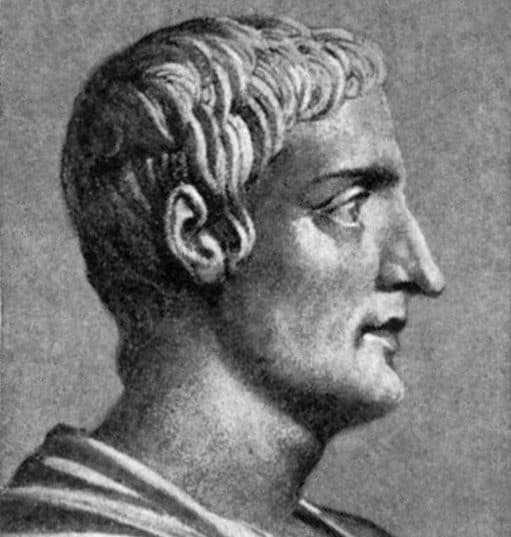
Image Credits: Caius Suetonius Tranquillus. Wikimedia Commons. Public Domain. Available here.

Comments
No comments yet. Be the first to share your thoughts.